Tao Te Ching Chapter 32

The Tao is forever undefined.
Small though it is in the unformed state, it cannot be grasped.
If kings and lords could harness it,
The ten thousand things would come together
And gentle rain fall.
Men would need no more instruction and all things would take their course.
Once the whole is divided, the parts need names.
There are already enough names.
One must know when to stop.
Knowing when to stop averts trouble.
Tao in the world is like a river flowing home to the sea.

 Jane English and Gia-fu Feng, 1989

 My favorite chapter so far. It seems redundant and unnecessary to comment at all. I’d suggest using this chapter as a koan, a mantra, a meditative focal point, over and over, expecting nothing of it, taking it at face value, letting it be what it is and letting it say what it says.

Posted in The Cascadian Wanderer | Leave a comment

Tao Te Ching Chapter 31

Good weapons are instruments of fear; all creatures hate them.
Therefore followers of Tao never use them.
The wise man prefers the left.
The man of war prefers the right.
Weapons are instruments of fear; they are not a wise man’s tools.
He uses them only when he has no choice.
Peace and quiet are dear to his heart,
And victory no cause for rejoicing.
If you rejoice in victory, then you delight in killing;
If you delight in killing, you cannot fulfill yourself.

On happy occasions precedence is given to the left,
On sad occasions to the right.
In the army the general stands on the left,
The commander-in-chief on the right.
This means that war is conducted like a funeral.
When many people are being killed,
They should be mourned in heartfelt sorrow.
That is why a victory must be observed like a funeral.

Jane English and Gia-fu Feng, 1989

There’s been a lot of brain play engendered by the last couple of chapters as evidenced by the nature of the commentary there, and it seems my commentary on this chapter is the culmination of that exercise. Obviously there are those who would wisely forego an extended and diffuse commentary if they were advised ahead of time of the ground ahead. Consider this that advisement.

I am a generalist and a path mixer and therefore confusing to many. Consider yourself warned. As a matter of fact, as soon as I am able to sign off on this chapter I plan to spend a lot of time embracing the sentiments expressed much more succinctly in my commentary on Chapter 32.

For starters, since paths are going to be mixed here and confusions abound, I offer as a conciliatory sentiment we can take to heart, in place of contention, this Vodou-based quote in a quasi-Jamaican patois from William Gibson’s Neuromancer:

             “I don’t understand you guys at all, “ he said. “Don’ stan’ you, mon,” the Zionite said, nodding to the beat, “but we mus’ move by Jah love, each one.”

And the following quotes aren’t going to lessen the confusion, but could enrich the context here:

“How we live is so different from how we ought to live that he who studies what ought to be done rather than what is done will learn the way to his downfall rather than to his preservation.”

 “Wisdom consists of knowing how to distinguish the nature of trouble, and in choosing the lesser evil.” 

“When evening comes, I return home and go into my study. On the threshold I strip off my muddy, sweaty, workday clothes, and put on the robes of court and palace, and in this graver dress I enter the antique courts of the ancients and am welcomed by them, and there I taste the food that alone is mine, and for which I was born. And there I make bold to speak to them and ask the motives of their actions, and they, in their humanity, reply to me. And for the space of four hours I forget the world, remember no vexation, fear poverty no more, tremble no more at death: I pass indeed into their world.” 

― Niccolò Machiavelli, The Prince

 So in this chapter, once again, we address destructive violence. In the previous chapter the sage offered counsel about force, pride and violence, and acting and doing and the achievement of purpose. The sage carries forward this theme in this chapter with observations about war, weapons, and killing, and the sorrows and losses which are inexorably attached to them.

I’ll start with some historical background about martial institutions taken from a description of ideas forwarded in The Warrior Ethos, a work by Steven Pressfield:

…Starting thousands of years ago with the hunters, protection for the tribe was best achieved as a group working together. The successful tribes evolved the warrior ethos practiced by the Spartans and others where courage, cooperation, and acknowledging the strength of the group over that of the individual, enabled the tribe or the nation to survive.

 Tribes and nations prospered or were conquered by the strength of the warrior culture, and as Philip of Macedon, Alexander the Great, Xerxes, and others fought their way across the Mediterranean and Central Asia, civilization was spread as conquerors and conquered traded goods, took wives, and exchanged ideas.

 This sort of intermingling led to the Indian warrior epic “Bhagavad-Gita,” expanding the warrior ethos to a loftier plane – from the war against one’s neighbor to an internal struggle to reach one’s better nature as Arjuna, the Gita’s hero, battles against enemies whose names can be translated as greed, sloth, and selfishness – all moral weaknesses that must be overcome.

This reference to the Bhagavad Gita has a context here. The Bhagavad Gita is, simply put, a philosophical and practical manual of human being and conduct presented in an allegory of war and the experiences there of Arjuna, the “greatest warrior,” and the guidance, counsel and instruction given to him by Krishna, an incarnation of Vishnu, regarded in the Hindu canon as the “Supreme God.”

There is a connection between the Gita and the Tao Te Ching. Victor Mair has observed that “…there are many remarkable correspondences between the Bhagavad Gita and the Tao Te Ching,” and also that “The Bhagavad Gita is essentially a manual of spiritual discipline that has applications in the real world; the Tao Te Ching is basically a handbook for the ruler with mystical overtones. The Bhagavad Gita advocates control of the mind and ultimate liberation; adherents of the Tao Te Ching espouse the indefinite protraction of the physical body.”

A spirited discussion has come out of Mair’s work which, among other things, observes differences between wu wei and karma yoga, and to a purist a certain amount of contention can arise favoring one or the other. I have no problem integrating the two.

I behold the all-inclusive, natural Tao to include Kamma (action and results) as something which can be observed and allowed to be from a perspective of wu-wei, non-action or non-doing.

I do not, however, believe that the sage advises us to be passive, inactive observants exclusively. In this chapter wu wei and karma yoga become mutually inclusive: The sage observes the karmic results of war.

If there is a synthesis of the two we can find it in the concept of selfless action as embraced, taught and demonstrated by the “peaceful warrior” Mohandas Ghandi (who called the Gita his “bible”), and espoused by Vivekananda,  Paramahansa Yogananda, and many others. We can also find it in the conduct of those who are perceived as “not peaceful” warriors who nonetheless demonstrate the ethos and essence of their peaceful counterparts.

In light of the discussion which followed my commentary on the previous chapter and the incorporation of wu wei and karma yoga which appears here it seems appropriate to ask a basic question. What is the purpose of the Tao Te Ching sage in these communiqué’s? Does the sage ultimately seek to nullify our separated personal dualistic existential experience by helping us create a singular, perfect focus on the inexplicable and indefinable Tao?

Or does the sage seek to advise us of how to balance ourselves here in this place where we navigate between poles of good and evil, action and inaction, seeing and knowing, mind and heart, intellect and intuition, earth and heaven, bully and saint, hard forms and soft forms, war and peace, death and survival, destruction and preservation, confrontation and deflection, existential conflicts and spiritual resolution?

In this chapter the sage once again acknowledges and accepts the existential realm and notes that weapons can be deployed there even by the wise man “when he has no choice.”

Since that’s the focus here, let’s take a look at that. Choice. I’ll take the sage at his word and accept that there are situations in which there is no choice and the use of weapons is necessary. What is the nature of such a situation? When does choice no longer apply, and all options disappear?

Given the background offered here so far, and dialing in to the boots-on-the-ground war experience of the individual confronted with a situation in which the use of weapons is necessary, we can look at a moment in time which occurred in the “Blackhawk Down” military action in Mogadishu, Somalia on the 3rd of October 1993:

During a raid in Mogadishu on 3 October 1993, MSG. Gary Gordon and SFC. Randall Shughart, were providing precision and suppressive fires from helicopters above two helicopter crash sites. Learning that no ground forces were available to rescue one of the downed aircrews and aware that a growing number of enemy were closing in on the site, MSG. Gordon and SFC. Shughart volunteered to be inserted to protect their critically wounded comrades. Their initial request was turned down because of the danger of the situation. They asked a second time; permission was denied. Only after their third request were they inserted.

MSG. Gordon and SFC. Shughart were inserted one hundred meters south of the downed chopper. Armed only with their personal weapons, the two NCOs fought their way to the downed fliers through intense small arms fire, a maze of shanties and shacks, and the enemy converging on the site. After MSG. Gordon and SFC. Shughart pulled the wounded from the wreckage, they established a perimeter, put themselves in the most dangerous position, and fought off a series of attacks. The two NCOs continued to protect their comrades until they had depleted their ammunition and were themselves fatally wounded. Their actions saved the life of an Army pilot.

 So. Obviously there is a larger picture available here. There is a good argument to be made against how and why these men were in this situation in the first place, and who put them there, and the reasoning which created their circumstances. These men were killing people violently with weapons, and people killed them violently with weapons, and for all the arguments to be made against the insane sourcing of that situation there is a paradox present there – the presence of a noble virtue. The fact of the moment is not arguable. It is a simple fact that these two men used violence and weapons in a situation where there was, by their lights, no other choice available to them.

What were those lights, what was the fundamental basis of their decision? When I speak with vets about war-time experiences a couple of common things are eventually distilled from all their varying perspectives which begin to answer that question.

First, there are some who have become aware through their experience that they placed their own self-will and ability to choose what their actions will be in the hands of others. Many do that unwittingly, and discover it through hard experience. Some, however, make that choice consciously, and in these individuals there is a noble consciousness which submits the individual to service of the group. These individuals are aware that in so doing they allow their lives and actions to be directed and used by others for a greater good than the good of themselves – the good of the community, the good of the tribe, the good of the family.

It’s so easy to veer from that seemingly noble conscious choice to the evil which is so often perpetrated by the powers who wield the nobly submitted warrior as a weapon of violence in pursuit of power and wealth for greedy, selfish purposes. But for the moment we are on the ground with the warrior. Let’s stay there with them.

There is a second common realization present in many vets I have known who directly experienced the violence of war. It came to each of them in the moment when they realized they were not fighting for country, or principle, or ideals, or even the greater good, because all of those things had become arguable and questionable and matters of opinion and perspective. It came to each of them in a moment when they realized they were fighting for the life of the person next to them, nothing less and nothing more. It came to them in the moment when they realized the most important thing to them was not whether they would live or die. The most important thing, the only thing, was that the person next to them should live.

Often this realization comes when the individual is certain their own death is imminent. What is remarkable is how many times in this moment vets have decided to die fighting for the person next to them rather than themselves. In that moment the macrocosmic social aggregate and the unbalanced perspective which has created war and sees it as a  necessity and takes human beings into it through their abdication of personal choice dissolves, and personal choice is resurrected. Or, more accurately, the individual becomes disconnected from the group cultural consciousness which he has submitted himself to and becomes reconnected to the spiritual connections and knowings and mandated actions which are in accord with and present in the divine self.

In that moment, these warriors achieve Arjuna’s spiritual victory over all moral weaknesses. They are focused, they are mindful, they are selfless, they are submitted to the One. When the choice is lost and the moment to deploy weapons comes, even then there is still a choice. We can choose who, and what, we fight for.

I believe that in the end, in Mogadishu, MSG. Gary Gordon and SFC. Randall Shughart realized Arjuna’s noble ideal in the personal choice they made in that moment. They were trained, imbued, and perfected in the modern martial warrior ethos, but they were not automatons. Social ethos did not make that final choice for them. Their humanity did. They did.

After the battle in Mogadishu there were many funerals on both sides. There was no victory there, only destruction and loss and mourning and lost lives. Yet woven into the dark horror of that misguided, insane, destructive mass event – the responsibility for which is traceable back to dark, selfish, insane perspectives – there are brilliant moments of human selflessness. On both sides.

I recall a friend telling me about a moment in Viet Nam which helped him to a realization of a related sort. I think it’s about what the sage speaks of about those moments which come when there is no choice, and the deployment of weapons is necessary. How do we know that moment?

My friend and another less experienced soldier were unable to make it back to their base after a reconnaissance mission and had to spend the night bivouacked in a tree. In the middle of the night my friend’s fellow soldier heard a noise in the jungle and whispered, “What was that?” My friend whispered this order back: “You did not hear anything. Nothing. If you heard something then you’ve made it real and we have to go see what it was. Just shut up and let it be. It’ll be real when it’s real. Until then, dammit, just let it be.”

It’ll be real when it’s real, and there’s no sense in borrowing trouble making it real when we have other choices. So long as there is a choice, the choice is to let things be what they are and, as the sage observes, hold peace and quiet dear to our heart.

What types of violence do we engage in? What types of violence are used upon us? The sage speaks of the use of weapons, and martial war. What weapons are in stock in our personal armory? What personal wars do we fight? What weapons do we deploy, what weapons are deployed against us? What martial perspectives do we see from and carry with us, unexamined or subtly and subliminally present in our own affairs?

What can be used as a weapon? Almost anything. A pen or pencil, a credit card, a rock, a belt, a handkerchief with a coin sewed into its corner, a sock full of quarters, household chemicals, almost any moveable object, the human body, religion, God, social status, educational attainment, race, gender, language, contempt, superiority, marginalization, rejection, ostracism – the list goes on and on.

What makes a thing a weapon? Intent. What marks a war as a war? Harm, destruction. Eventually it boils down to whether you want to use weapons or not, whether you want to make war or not. Do you? If you do, then expect those weapons to be deployed against you, expect their effects on yourself, expect the consequences of war. The karmic principle is set in stone, cast into the fundamental foundation of the dualistic human experience. Do you seek a victory? Then expect a defeat.

The words of the sage are good to keep in mind. Keep peace and quiet dear to your heart. There is no victory when you use weapons against others, and so yourself. When the fight happens a price will be paid. Do not employ weapons against yourself or others. There is no joy when weapons are used to gain personal fulfillment. Know what you seek and what you will lose.

The sage observes that violence with weapons comes when there is no other choice. When you encounter that moment, he says, remember: if you like to win then you will lose, you will not be fulfilled. War at any level brings destruction and loss. It should be followed by a funeral mourning those who think they have won something. They have lost, and are lost. There is war. There has been war. There will be war. Even so, hold peace and quiet dear to your heart.

The sage is tricky. He observes what happens when there is no choice. And in this way he leads us to find a singular truth for ourselves: there is always a choice.

That being said, I believe it is possible I could be confronted with a situation in which I would chose to use a weapon with deadly force. It hasn’t happened so far in my life, and I pray it never does. If it comes, the choice to do so will be a choice I make, not a choice the situation makes for me, and I will pay the price the sage speaks of. Volition – conscious choice – is always present, and it’s a cop-out to claim the situation called for it and I could do nothing else. Until such a moment appears in my life I will not make it real until it is real, I will let things be as they are, and I will hold peace and quiet dear to my heart.

***

In the comments section of the previous chapter, Louis shared a quote from Paxton Robey which zeroes in through all the confusions of the situations I have observed here to concentrate the attention on what we, as individuals, might correctly do when beholding such events and then experience the desire to correct them.

Robey observes, “A Course in Miracles’ says that all correction belongs to the Holy Spirit. It also says that when we perceive an error, it is our perception that needs fixing, not the situation we are perceiving. So when we believe someone is in error we send them light. Hopefully we have learned to never again correct them or commiserate with them.”

I agree. What I would add to that good counsel is that, beyond perceiving and then healing our own error in finding fault in others, there is the matter of how we are to “send light.”

Is sending light the matter of a casual, benevolent prayer sent in the direction of others in the spirit of wu wei and then commending them to their path, allowing them to be who and what they are, accepting their condition as a fact of life which we are unable to judge? Yes, it is. Yet it is more than that, too.

When we actively embrace our existential being and the choices made there between good and evil, light and dark – choices which are intrinsic and inseparable from the ground – action is a part of that realm. Sages inform us throughout history of what right action is, and that information wakes us to what we already know about right action because that knowledge is inseparable from and intrinsic to the spiritual ground we all share in the One. We awake to that, and so awakened are compelled to embrace and support and demonstrate and express it and share it.

Right action is a matter of speaking our light, living our light by example, sharing our light – and the confusions we experience there as well – in deeds of example, not applied as corrections or coercions to others but rather as expressions of what we know ourselves to truly be, of the goodness and light we have found within ourselves which we share with all of creation.

Posted in The Cascadian Wanderer | 3 Comments

Tao Te Ching Chapter 30

1.

 Warning Against the Use of Force

He who by Tao purposes to help the ruler of men
Will oppose all conquest by force of arms.
For such things are wont to rebound.
Where armies are, thorns and brambles grow.
The raising of a great host
Is followed by a year of dearth.

Therefore a good general effects his purpose and stops.
He dares not rely upon the strength of arms;
Effects his purpose and does not glory in it;
Effects his purpose and does not boast of it;
Effects his purpose and does not take pride in it;
Effects his purpose as a regrettable necessity;
Effects his purpose but does not love violence.

(For) things age after reaching their prime.
That (violence) would be against the Tao.
And he who is against the Tao perishes young.

Lin Yu Tang

2.

Whenever you advise a ruler in the way of Tao,
Counsel him not to use force to conquer the universe.
For this would only cause resistance.
Thorn bushes spring up wherever the army has passed.
Lean years follow in the wake of a great war.

Just do what needs to be done.
Never take advantage of power.
Achieve results,
But never glory in them.
Achieve results,
But never boast.
Achieve results,
But never be proud.
Achieve results,
Because this is the natural way.
Achieve results,
But not through violence.

Force is followed by loss of strength.
This is not the way of Tao.
That which goes against the Tao comes to an early end.

Jane English and Gia-fu Feng

Chapter 29 is about being, and the sage counsels acceptance of things as they are. There’s a lot of philosophy going on about being.

Chapter 30 is about acting and doing, and the achievement of purpose, and here the sage offers cautions and guidance and observes the consequences of not acting and doing in cooperation with the Tao. There’s a lot of good advice going on about acting and doing.

Sometimes I wonder which is more useful, the philosophy of being or the advice about acting and doing.

In this chapter the sage advises us that force, pride, and violence in the pursuit of victory are wrong, no matter whether exercised by the individual or the tribe. Such actions produce waste and leave wastelands in their wake, and weak land and weakened people and early death.

Doing and Being. Earth and Heaven. Yin and Yang. The sage obviously accepts that there is a dualistic nature to human being, and does not favor one over the other. The counsel here is about balance of the two and mindfulness of each in what we do to achieve the purposes of our lives.

What are our purposes? We effect our purposes, we achieve results, that’s an obvious human characteristic. We have evolved as an adaptive, manipulative, thinking species which beholds fact, whether from the prehistoric cave or the megalopolitan high-rise. Then we act in response to the facts before us to effect the purpose of our existential needs.

What are those needs? Sustenance, shelter, safety. How do we get them? Work,  cooperation, community. Are our needs any more complex in the megalopolis than they are in the cave? Perhaps, in the sense that the environment we navigate in the contemporary world is highly complex and interrelated. Our world is complicated by blurred lines between needs and wants, requirements and desires, and a burgeoning, ever-present stimulation of basic human appetites luring us to ever higher levels of  aggressive, violent consumption. This is exactly the thing the sage counsels us to avoid.

And it is exactly the thing which, in spite of all our applications of our complex processing powers as existential beings in our pursuit of survival, we fail to process adequately. Aggression and violence will not serve human beings. Yet too often we remain unaware of how aggressive and violent our ways and means are.

What violence and aggression are present if I live and work according to the ways and means presented to me by the complex structure of my culture? Hell, in America the ways are legion, practically uncountable, and seemingly unavoidable. In order to get along I have to go along with the status quo. Yet under the smooth, complacent surface of accepting things “because that’s just the way things are now,” there is a dark depth of violence and aggression underpinning the dispensations we have available to us at the great, wasteful smorgasbord which our culture has convinced us is the place where we can slake the appetites our culture – not our nature, but our culture – has given us.

My culture is ruthlessly Darwinian, a place where, because of the standard of living which it affords me, the resources and energies and very lives of other people on this planet are aggressively, violently taken to serve it. Sometimes I look at all the things which are in my house, and marvel at the thousands and perhaps tens of thousands of human beings who have been involved in creating them. I am awed by the tremendous cooperation and complexity which it takes to do that, and I am appalled at the cost.

I live humbly, and my possessions are few, and yet even in these circumstances I am aware that what I have to meet my basic needs according to the terms of my culture is excessive, and wasteful. Human beings have died so that I might have what was taken from them. It is just that sadly, starkly simple. My physical security and comfort here are predicated upon violent and aggressive ways and means applied to my planet and my fellow human beings.

How can I reconcile that, how do I live with that? Well, obviously I do. I deplore it, I see it for what it is, I behold the fact of it and I wonder if there isn’t something that can be done about it. But is there? Really? I mean, it’s obviously a fact that this is the way things are these days, and I’m just going to have to get over the obvious horror of it and carry on, right?

How would the sage advise me to conduct myself in the midst of such imbalance, as a passive beneficiary of such aggression and violence? Is the sage shouting in the wind? Are these words being carried away by the storms of modernity which today show clear promise of the end of modern human civilization because of our violent, aggressive practices?

Perhaps. But I hear the sage’s words. If my species as a whole does not, it’s just another fact which, in pursuit of my own survival, I must confront. How do I survive the unwitting vector of my own species?

If the natural way has been lost and humanity as a whole is proceeding on an unnatural way, a way that achieves results through violence, how would the sage advise me to proceed? Would the sage soothe me with philosophy, reminding me of my true nature? That would be fine, that’s a good thing to remember. Yet I wonder what practical advice the sage might offer to guide me through the spiritual wastelands of our prevalent and current aggressive, violent human culture. Or has the sage already advised me here in this chapter about how to proceed?

The sage obviously recognizes violence and aggression, and advises against it. Am I to be non-violent and unresisting? Am I to accept even the violent ways and means employed which supply provision to me far beyond my basic needs at the cost of human and planetary life?

Apparently I am, and this does not sit well with me. What, on a practical level, beyond the simple soothings of philosophy, am I to do? How am I to act?

Posted in Tao Te Ching | 5 Comments

Tao Te Ching Chapter 29

1.

There are those who will conquer the world
And make of it (what they conceive or desire).
I see that they will not succeed.

(For) the world is God’s own Vessel
It cannot be made (by human interference).
He who makes it spoils it.
He who holds it loses it.

For:  Some things go forward,
Some things follow behind;

some blow hot, and some blow cold; 

Some are strong, and some are weak;

Some may break, and some may fall.

Hence the Sage eschews excess, eschews extravagance,
Eschews pride.

Lin Yu Tang

2.

Do you think you can take over the universe and improve it?
I do not believe it can be done.

The universe is sacred.
You cannot improve it.
If you try to change it, you will ruin it.
If you try to hold it, you will lose it.

So sometimes things are ahead and sometimes they are behind;

Sometimes breathing is hard, sometimes it comes easily;

Sometimes there is strength and sometimes weakness;

Sometimes one is up and sometimes down.

Therefore the sage avoids extremes, excesses, and complacency.

Jane English and Gia-fu Feng

Let it be.

The universe, the world we live in, the experience we have here – it is all whole, and holy. Fuss with it, fuss about it – and you screw it up. Let it be what it is, and be with it, and do not hold yourself above it, or below it, or apart from it.

 Sometimes you are ahead and sometimes behind.

Sometimes you are up, and sometimes down.
Sometimes breathing is hard, sometimes it comes easily.
Sometimes you are strong and sometimes weak.

Do you think you can improve on this? You can not.

It is what it is.
Things just are.
Let it all be what it is, and be with it,
and do not hold yourself above it, or below it, or apart from it.

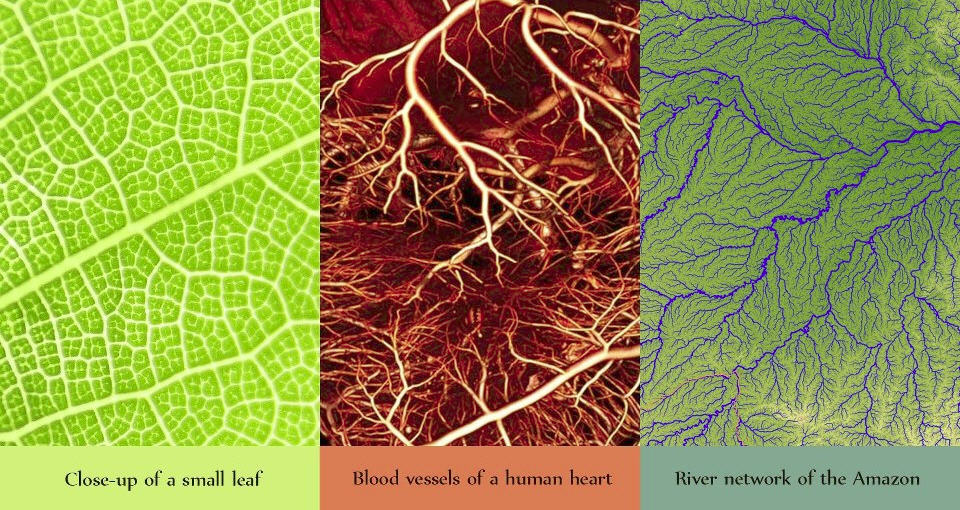
Nature vessel networks

Posted in Tao Te Ching | Leave a comment

There’s a reason for everything

On the porch with coffee this morning I wonder if there is a reason for anything until we give it one. And so I give a reason to this thought which comes while a chain of geese who winter on the valley floor here fly between me and the morning mountain skyline to the southwest, and the edge of morning flares along the eastern ridge.

And as quickly as it appeared, the thought is gone.

Posted in Ruminations | 1 Comment

Tao Te Ching Chapter 28

1.

He who is aware of the Male
But keeps to the Female
Becomes the ravine of the world.
Being the ravine of the world,
He has the original character (teh) which is not cut up.
And returns again to the (innocence of the) babe.

He who is conscious of the white (bright)
But keeps to the black (dark)
Becomes the model for the world.
Being the model for the world,
He has the eternal power which never errs,
And returns again to the Primordial Nothingness.

He who is familiar with honor and glory
But keeps to obscurity
Becomes the valley of the world.
Being the valley of the world,
He has an eternal power which always suffices,
And returns again to the natural integrity of uncarved wood.

Break up this uncarved wood
And it is shaped into vessel
In the hands of the Sage
They become the officials and magistrates.
Therefore the great ruler does not cut up.

Lin Yu Tang

2.

Being the stream of the universe,
Ever true and unswerving,
Become as a little child once more.
Know the white,
But keep the black!
Be an example to the world!
Being an example to the world,
Ever true and unwavering,
Return to the infinite.

Know honor,
Yet keep humility.
Be the valley of the universe!
Being the valley of the universe,
Ever true and resourceful,
Return to the state of the uncarved block.

When the block is carved, it becomes useful.
When the sage uses it, he becomes the ruler.
Thus, “A great tailor cuts little.”

Jane English and Gia-fu Feng

Is it all really so arcane and abstruse and solemnly profound and weighty as these translations make it sound? Is the wisdom of the sage really all that difficult to grasp? It seems to be common sense to me.

We are considering the ravine now. In Chapter 6 it was the Valley Spirit, the divine feminine, the holistic, intuitive capability inherent in the human perceptive mechanism which is directly connected, naturally, to our life experience without benefit of the confusions of upper cortical complexity. It is the direct connection we have to being in the body, in the mind, in life and of it, sharing an experience we have in common with the universe and every living thing in it from the first single-celled life form to our own complexly evolved form.

In addition to the “ravine” we also have the experience of duality inherent in mind, the experience of pieces comprised of points which create distance, time, direction, value, diametrics like good and bad, safe and dangerous, and so individual action paths within the common experience and place we all belong to.

And then we have the balance between the two. The balance of mind and heart.

Too much mind, and we are no longer connected to life, to each other, to the earth, to the life force of the universe. We are connected to bits and pieces, and become a bit or a piece ourselves.

Too much heart and we are disengaged from the mind and deny half of our human reality. Not a bad thing in the sense that such a connection effectively removes us from the troubles of our mind experience. Yet not necessarily a good thing either because, unbalanced, it still involves invoking duality, choosing one aspect over the other, and so denies its true essence – an experience which involves both the heart and the mind.

The sage tells us a simple thing in chapter 28. The mind can become unruly when it forgets the heart. It will mow down entire forests in pursuit of its own ends unless it is in balance with the heart. In balance with the wisdom of the heart it will be governed rightly. It will form a useful wooden bowl instead. The sage cuts up little, acting with graceful balance of heart and mind. The sage has a separate life, simultaneously connected to all life. A paradox? An arcane, diffuse, elusive thing? No. Actually, it’s just a simple fact. It’s just, as the sage said at the end of the previous chapter,

 The subtle, secret center of the Tao.

Or, as JJ Cale said about the heart’s groove and the mind’s motor,

Some like this and some like that
And some don’t know where it’s at
If you don’t get loose, if you don’t groove
Well, your motor won’t make it and your motor won’t move…

Posted in Tao Te Ching | 1 Comment

Tao Te Ching Chapter 27


1.

On Stealing the Light

A good runner leaves no track.
A good speech leaves no flaws for attack.
A good reckoner makes use of no counters.
A well-shut door makes use of no bolts,
And yet cannot be opened.
A well-tied knot makes use of no rope,
And yet cannot be untied.

Therefore the Sage is good at helping men;
For that reason there is no rejected (useless) person.
He is good at saving things;
For that reason there is nothing rejected.
– This is called stealing the Light.

Therefore the good man is the Teacher of the bad.
And the bad man is the lesson of the good.

He who neither values his teacher
Nor loves the lesson
Is one gone far astray,
Though he be learned.
– Such is the subtle secret.

Lin Yu Tang

2.

A good walker leaves no tracks;
A good speaker makes no slips;
A good reckoner needs no tally.
A good door needs no lock,
Yet no one can open it.
Good binding requires no knots,
Yet no one can loosen it.
Therefore the sage takes care of all men
And abandons no one.
He takes care of all things
And abandons nothing.

This is called “following the light.”

What is a good man?
A teacher of a bad man.
What is a bad man?
A good man’s charge.

If the teacher is not respected,
And the student not cared for,
Confusion will arise, however clever one is.
This is the crux of mystery.

Jane English and Gia-fu Feng

“Teachers have the most to learn, learners have the most to teach, and preachers move a lot of air. It doesn’t bother the air.”

Learners teach, and teachers learn.
If the teacher is not the student then the lesson is neither loved nor learned.

No matter how praised and successful the teacher is,
no matter the books and websites and media appearances the teacher makes,
no matter how clever the teacher is –
when even one person is abandoned
the light is lost and confusion follows.

Take care of all persons,
abandon no one,
lest you abandon yourself.

Take care of all things,
abandon no thing,
lest you abandon the light.

The good and the bad are one thing.
The teacher and the student are one person.
The one thing and the one person are One.

This is the subtle, secret center of the Tao.

Posted in Tao Te Ching | Leave a comment

Tao Te Ching Chapter 26

1.

The Solid is the root of the light;
The Quiescent is the master of the Hasty.

Therefore the Sage travels all day
Yet never leaves his provision-cart.

In the midst of honor and glory,
He lives leisurely, undisturbed.

How can the ruler of a great country
Make light of his body in the empire (by rushing about)?
In light frivolity, the Center is lost;
In hasty action, self-mastery is lost.

Lin Yu Tang

2.

The heavy is the root of the light.
The still is the master of unrest.

Therefore the sage, traveling all day,
Does not lose sight of his baggage.

Though there are beautiful things to be seen,
He remains unattached and calm.

Why should the lord of ten thousand chariots act lightly in public?
To be light is to lose one’s root.
To be restless is to lose one’s control.

Jane English and Gia-fu Feng

How can we master the kingdom of the ten thousand chariots? How do we master the phenomenological realities of our existential manifestations, the “ten thousand things,” the baggage in our provision cart the sage of the Tao Te Ching speaks of here?  How do we hold to a center whose center appears not to hold and instead spires ever wider in its gyrations between the poles of the dualistic mind?

We think we know. So onward and upward and downward and aroundward we go on this dizzying loop-the-loop constituted of the complex synapses of the linguistic mind.

Is our singular perceptive regard merely light frivolity and hasty restlessness and wandering far and wide and away from what is with us, and within us? Traveling with our baggage and our provision cart in the world, with our perceptions of honor and glory and beautiful things and mundane amusements, are we manic and disturbed and fixated and frantic rather than leisurely and undisturbed and unattached and calm? Yes, we are.

Until we remember that the still is, indeed, the master of unrest. That’s the key to ruling, rather than being ruled by, the ten thousand things. Be still and at peace, and know the I Am. Know “that which is thou.” Identify yourself, and rest in it, and let it be.

When the mind is at peace,
the world too is at peace.
Nothing real, nothing absent.
Not holding on to reality,
not getting stuck in the void,
you are neither holy or wise, just
an ordinary fellow who has completed his work.

P’ang Yün

Posted in Tao Te Ching | Leave a comment

Tao Te Ching Chapter 25

1.

Before the universe was born
there was something in the chaos of the heavens.
It stands alone and empty,
solitary and unchanging.
It is ever present and secure.
It may be regarded as the Mother of the universe.
Because I do not know its name,
I call it the Tao.
If forced to give it a name,
I would call it ‘Great’.

Because it is Great means it is everywhere.
Being everywhere means it is eternal.
Being eternal means everything returns to it.

Tao is great.
Heaven is great.
Earth is great.
Humanity is great.
Within the universe, these are the four great things.

Humanity follows the earth.
Earth follows Heaven.
Heaven follows the Tao.
The Tao follows only itself.

J. H. McDonald

2.

Something mysteriously formed,
Born before heaven and Earth.
In the silence and the void,
Standing alone and unchanging,
Ever present and in motion.
Perhaps it is the mother of ten thousand things.
I do not know its name
Call it Tao.
For lack of a better word, I call it great.
Being great, it flows
I flows far away.
Having gone far, it returns.

Therefore, “Tao is great;
Heaven is great;
Earth is great;
The king is also great.”
These are the four great powers of the universe,
And the king is one of them.

Man follows Earth.
Earth follows heaven.
Heaven follows the Tao.
Tao follows what is natural.

Jane English and Gia-fu Feng

And so the sage again returns us to remembering the great Tao. He beholds its sweep, its inexpressible perfection, its eternity and endlessness, and in the last four lines he forms the narrative path which leads beyond all words and forms of separation and conducts us to the essence and source of being.

Release, and thus peace. It’s the message of the sage of the Tao Te Ching, the guidance of the Buddha, the last message of Christ. It comes to us over and over in its simple, profound clarity and is obscured in the fog of our existential, personal perspective; lost in the complex and inchoate wanderings of mind and ego as we seek to put our understanding in the boxes of words and so construct a linear narrative which we can follow to the essence of our being. What a life this is!

I’ve been carrying on a wonderful correspondence with my uncle’s family. He passed on recently, and in the wake of his passing wonderful things have surfaced. This week my commentary reflects the fullness of these moments.

The only thing I can think of to share here in this moment is a letter sent from my heart to the hearts of the loved ones I share this loss with. It’s all I have to say here.

***

Dear J and B and G,

Some sharing of my own thoughts and feelings about “Darf’s” life – and by the way, how did that come to be his nickname? From what I’ve been able to come up with it seems to be a very affectionate one, used by the people who knew him best. Let me in on the secret, I’d like to join Darf’s inner circle if I could, even if only as an honorary member.

I now have G’s account of her time with him in his last days, and I have seen the great photo on B’s web site of the two of them together, smiling. J, I have felt your poignant pains and the depth of your love, and I honor you for the suffering and victory of your life which you have shared in your courageous and honest and true letters to me, and which is held within the poem formed in you, speaking your heart’s truth.

I can’t express how good it has been to reconnect with each of you. I am caught up in what Rumi characterized as the only thing we really want and often forget – love’s confusing joy.

Love is indeed a confusing thing, painful and a great joy, as it is in this time we are sharing and in the greater life we share. B’s latest letter is once again full of the wisdom you all have so obviously gained in abundant measure. Particularly relevant here is her observation that words, while quite useful, are inadequate to speak the heart’s truth, that “the boxes words offer are not always the right size or shape for what you want to put in them.” So very true, B, and yet we are devoted to do our best there, just as we are in our lives.

If I were present there now I would not speak any words. I would wrap my arms around each of you, and hug you close, and speak my heart that way. And with my eyes closed I would hug the two small children who were for a time – and still are – my little sisters, and the strong young woman who gave a mother’s love to me, and the young, wondrous strange man, my uncle, brother of my dead father, present in each of you, who took me in when no-one else would and did the best he could to care for me… and the tears that well in my eyes at this moment would be there, flowing toward the healing we all seek here and now.

The correspondence we are sharing reveals our deep feelings and confusions and common desire to reconcile ourselves with an understanding of who Darf was, really. When my brother died a year and a half ago I yearned for there to be a “Speaker for the Dead,” a person envisioned in the Orson Scott Card novel of that name. The Speaker was a person who would gather an unflinchingly full picture of a person’s life and then speak the truth of the mind and heart there. The Speaker’s perspective brought understanding and healing and acceptance and recognition of the unique and intrinsic goodness of the person’s life.

I attempted to be such a speaker for my brother, but in the end I realized his life spoke its own truth. I spoke for him from within the perspective of love’s confusing joy swirling in me, beholding him from where I stood, putting the essence I beheld into the boxes of words. I did find in that process a partial understanding of who he was. It was enough of an understanding to lead me to acceptance of things as they are, and a release of my desire to know things about him which, with his passing, I could never know.

In the end, after the confusions of love are arranged in the boxes of words and we have a linear narrative extracted from the complexity of mind, the mystery of God takes over. The narrative joins with the singular, whole, One gestalt which we are simultaneously joined with and separated from, and the seeming paradox and conflict there resolves into peace and acceptance and understanding. We are able to let life be what it is, and accept the pains and joys therein with equanimity. We are here, forming the narrative of that process, together. I speak here from the perspective of my own love and the confusing joy in me. It’s all I can do. It’s all I have.

Here’s what I have seen as I have looked at what we are all looking at. Darf was good, kind, gentle, sweet, thoughtful, industrious, dedicated, devoted and loving. There are too many instances of each present in the record of his life to deny the presence of any of them.

I’ve looked at loving the closest because of the mixed messages I often perceived coming from him. I’ve realized that the attenuated emotional expressions and the seeming distance and reserve present in his communication about feelings were not his message. His message was always, “I care about you. I love you.” The mix-up was partially on my end, where I waited for what I wanted to hear, in the way I wanted to hear it, and so I often missed the true message he spoke.

I have looked at the things he did and how he did them, and the things he spoke of and how he spoke them, and of the things he couldn’t speak easily of which, if he could have, he would have spoken over and over again to each of us in the way we wanted him to speak – because he did, truly, love us. I suspect he sensed what we desired in the way of affection, expressed, and it hurts me to think that he may have taken his awkwardness in that as an insufficiency in himself rather than simply a characteristic of his particular humanity.

When I look at him again, from his perspective, leaving myself out of it, I am certain he was a loving person, a man with deep attachments, and a good man. He was formed into the gem he was by his nature, his nurture, and formative existential waypoints, and if the light which refracted to us from some of his facets was puzzling, it was only puzzling to our own personal perspective. God saw him in perfect clarity. God, which is in us, and around us, and throughout all things, saw him with perfect clarity as the unique, wonderful being he was and is and will always be. And because that seeing is in us, we can see him in the same way.

I think that in Darf’s final moments a light shone out of the essence which we all behold from our different perspectives, a beacon for us all from the very heart of God. G was there and it refracted through her and Darf and between them, and it was about each of them, but it was so much more than that. It was an ineffable infusion of grace in those moments which delivered an answer for us all, here and now. Gwen wrote:

I sang ‘Hawaii Aloha’ to him – and felt more sense of a response, his mouth moving, swallowing. I took him on a guided meditation about being back in Hawaii, feeling the warmth of the sun and the coolness of the breeze on his face, the intense blues of the skies and the seas, and the shades of green…but also the sense of coming home, going back to where you belong, meeting with aloha and love, finding a deep peace (obvious metaphor…)… da kine. I also spoke of all of you, the love we all had for him, and all the things you would want to say to him..what a good father and grandfather he’d been, how much he’s done for so many people and the love and gratitude they had for him, and that they were all with him now. All through this I could hear his breathing relax more and more. In some indefinable way I felt his being ease, like something was relaxing, letting go, and finding a deep peace and calm.

That’s the shortcut across the narrative of our own grieving processes. If we follow that light home, we’re saved. In that light I have closed my eyes and found myself standing at the Pali lookout holding the urn of his ashes in my hands, tears streaming out of me, soaking my shirt. I hold the urn high above my head and let the winds take him to the sea and sky and sand and rocks and the verdant, charcoal, azure essence of life there. I commend him to the gods, the spirits, the old ones there. And then my knees break, and I bow my head, and I pray, saying, “He was a good man. Take care of him.” And they say they will.

My love to all of you. I will pursue the narrative with you as you wish, I am myself inconsistent and bounce back and forth between knowing the truth and seeking it. I am engaged in both. There is a narrative record in Darf’s life which explains much and can be put to good use in the healing process. When that comes round again in me I’ll share what I locate there. For now I just want to say,

Aloha oukou. Malama pono. My love to you all. Keep doing what you do so well, and which you are clearly meant to do, and be well,

Bob

Posted in Tao Te Ching | 2 Comments

Tao Te Ching Chapter 24


1.

Those who stand on tiptoes
do not stand firmly.
Those who rush ahead
don’t get very far.
Those who try to outshine others
dim their own light.
Those who call themselves righteous
can’t know how wrong they are.
Those who boast of their accomplishments
diminish the things they have done.

Compared to the Tao, these actions are unworthy.
If we are to follow the Tao,
we must not do these things.

J. H. McDonald

2.

He who stands on tiptoe is not steady.
He who strides cannot maintain the pace.
He who makes a show is not enlightened.
He who is self-righteous is not respected.
He who boasts achieves nothing.
He who brags will not endure.
According to followers of the Tao, “These are extra food and unnecessary luggage.”
They do not bring happiness.
therefore followers of the Tao avoid them.

Jane English and Gia-fu Feng

Since chapter 17 the sage has been speaking of self-centered manifestations of behavior and observing the benefits of transcending the selfish bias of the low form of ego which is self-interested, self absorbed, and separated from our common humanity, life, the universe and the Tao.

In these chapters the sage speaks of what we allow to rule us (rulers); what we allow to coerce us (the ways of the people, and societal value systems); and how we individually behave and act.

In chapter 21 the sage remembers the great Tao. It’s a good practice, modeled for us, this pausing from time to time to recall the essence. The sage demonstrates, by example, to remember to first, last, and in between all our personal excursions in this life take the time to remember who and what we are universally, beyond the locality of our personal experience.

In the next three chapters the sage then turns back yet again to observe and address the experience of the self-mind. The sage lists the choices and ways and means and resultant manifestations of the low form of ego which chooses by right of its own free will to inhabit and misuse mind for selfish purposes rather than avail itself of the higher wisdom of the known essence, which it prefers to ignore so long as it perceives itself to be separate, alone, and at risk.

Has anybody else noticed how much chiding there is present in the guidance sages and enlightened ones give us on most spiritual paths? Why so much? “Do this, not that,” the sage informs us. And Christ often admonished his disciples, saying more or less, “No, that’s not it! Gregoreite! Wake up!” Why so much direction?

Because it is the direction, the guidance, we are called to give to our own separated ego.

***

I’ll confine my commentary on this chapter to those remarks.

I would like to say thank you to you, Louis, for your condolences extended here on the recent passing of my uncle, Dick Griffith. He was quite a guy, Louis. A lawyer, he had the good fortune and mind and ability to rise high in his profession. He argued a case before the Supreme Court, and regarded that as the pinnacle of his profession. A brief description of a few of his accomplishments in the professional realm can be found at: http://www.bizjournals.com/pacific/stories/2000/11/27/smallb2.html?page=all

I will miss him. I think that regardless of his many worldly accomplishments and attendant opportunities to live a selfish life, he would have embraced this chapter of the Tao Te Ching and affirmed it wholeheartedly.

We shared a lifelong grief in the passing of my father, his brother, at the age of 26. My dad was, as I said in my earlier comment, a person venerated by three generations in the community he grew up in and where he lived most of his life. He earned that veneration by virtue of his extraordinary vitality and passion for life, his ability to connect with others without regard to their station or status or nature, his straightforward honesty, his exceptional mind, good heart, loving ways, and ability to work hard at whatever he chose to do. He went to Duke University to study medicine, decided instead to become a farmer, did so successfully by combining agricultural science into new farming techniques during the early 1950’s, and died prematurely and tragically in a car accident in 1956, leaving his community bereft and his family a world of uncertain ground. My uncle and I carried that loss heavily ever since, in indescribable ways, and that shadow, for better and for worse, was present in all our correspondence and interactions.

I am reflecting on how my uncle would have regarded the sage’s guidance in the Tao Te Ching, and hope to find some answers in a new correspondence with his daughters, one a writer, the other a professor of Philosophy and Religion at the University of London. Their insights in that regard will be interesting, to say the least. I will be glad to share what I learn there as time goes on.

Thanks again, Louis, for your thoughts and prayers. You have my very best regards, and I send my love to you and yours.

Posted in Tao Te Ching | 1 Comment