The Examined Life, Part 2

It goes on, slowly. The designated miscellaneous stuff closet is slowly being emptied of photographs and old records and things we thought too good to throw out in the moment, things that have gone far past their moment now. Out they go. I pause at nearly everything. The first business license, an old driver’s license, something our daughter dashed out in crayon in preschool, sometimes even photos that record earlier waypoints of my life, people and places now left behind, passed beyond.

And there’s all the old writing. A good-sized box of it, much of it typewritten, dating from 1982 to 1990, when I bought my first computer. My art. Words, expressing thoughts and feelings in musings and vignettes, short stories and poetry, essays and word scraps.

Behind my studied gaze at these things there’s a sort of twitching, tail-switching ambivalence about the value of it all. Is the present the only worthwhile place to exist? Is the past done with, gone beyond, even non-existent? Yet these things are in the present, and the present is tethered to the past by them.

Thomas Wolfe observed that the artist seeks “… to make his life prevail through his creation, to wreak the vision of his life, the rude and painful substance of his own experience, into the congruence of blazing and enchanted images that are themselves the core of life, the essential pattern whence all other things proceed, the kernel of eternity.”

In my exploration of the written archives of my life and my current reflections on the simultaneous insignificance and exquisite uniqueness of every person’s life, I’ve been seeking a place where the past and present are comfortably reconciled. It’s a puzzle I’ve been slowly putting together. Now, after trying on the perspective that the past is gone and non-existent and unworthy of attention – and never really being settled comfortably into the notion – I see my way.

It’s all of a piece. Past and present and future. Notwithstanding all the guidance set out by gurus of every rank and ilk and age and era exhorting me to “be here now,” I am inclined to think that those exhortations have been abbreviated and truncated by well-meaning efforts to tailor them to simple statements for simple minds. What has been omitted is the information that past, and present, and future – are all here, now.

This has been a topic of speculative conversation for awhile around here, and this morning Lenore and I nailed it down. A proof, yet again, of the power of the place where two (or more) are gathered together. She’s been reading Eric Hoffer’s “The True Believer.” She bookmarked Hoffer’s observations for me about how mass movements affect the perspective on the past, present and future in the minds of their true-believing adherents and the recruits they proselytize.

I read it, and it’s all about imbalance. Too much focus on one or the other or the other, and never a balance of all three. The culmination of our resultant discussion being a conversation which came shortly thereafter.

I was going out the backdoor with the firewood sling, on my way to get another bundle of chunks and splits to stack by the stove. It’s going to be a rainy, chilly weekend here and I’d just used up the last to start the morning fire, but Lenore didn’t know I’d already done that. We usually have two fires, one in the morning and another at night.

“Looks like we’re going to have a fire,” she said to Charlie. He wagged his tail. He likes fires in the stove.

“We already have one,” I said, “I’m just going out to get some more wood for the one tonight.”

Lenore cropped from Baby GabeShe is so quick. She looks at me, and twinkles – you have see it to know what I’m talking about – and she says, “So-oo, there’s a fire in the past that you started that’s in the present now, and there’s a fire in the future that you’re starting now, in the present.”

I love this girl.

It’s all of a piece. Balance – that’s the thing.

Posted in Lenore, Wandering Thoughts | Leave a comment

RIP Terry Pratchett

Author Terry Pratchett

“The truth may be out there, but the lies are inside your head.”

“Goodness is about what you do. Not who you pray to.”


“Seeing, contrary to popular wisdom, isn’t believing. It’s where belief stops, because it isn’t needed any more.”

–**–

The passing of Terry Pratchett – a simpatico soul of mine, a wise seer, a Lao Tze of this dimension – sends a soft ripple through the air of our mountain valley.

Along with my slow yet steady excavation of the archives of my own life as I continue to “get light,” those energies have collided here, on the porch with coffee.

And so, as is my way, I’ve brought to words that intersecting node of the rings upon rings upon rings created by the energy of our two discrete pebbles dropped into the pond of time here. Words seeking, at best, to describe the indescribable – because words have limits. Mine especially, I might add, because I am an amateur in the art, scribbling in the shadows of folks like Terry Pratchett.

Yet I share one thing at least with him in our mutual embrasure of the medium. We both know the transcendent connection words offer is a mere broadcast, sent out on a certain frequency, traveling ever outward into the universe, to be picked up and heard, if at all, by an unknown receiver. And whether it is received or not doesn’t matter. What matters is the exquisite, solitary, and unique frequency of the broadcaster – a frequency every human being has been gifted with. It’s called their life.

When I peruse the collections of Terry Pratchett quotes on the internet and in books I’m struck with how often they mostly feature the silliness of the Punch and Judy show in front of the curtain, and how seldom they reflect the master philosopher who is pulling the strings and levers and animating the sock puppets of imagination with his craft from behind the curtain. Struck, but not surprised, and I’m sure he wasn’t either.

It’s the broadcast that’s the thing. The reception – well, that’s somebody else’s business.

Terry Pratchett’s frequency travels on through the universe, and always will.

Posted in Wandering Thoughts | 1 Comment

Getting Light 2015: Getting Here

Onward, downward, backward and inward it goes. Onward with the sorting and culling and classifying. So far I have seven fairly good-sized boxes ready to export – three of books, a fourth for the thrift store, two more of paper to be recycled, and one marked “burn/shred” which is mostly various records containing our social security numbers and material useful to identity thieves.

Although, when I think about it, I really don’t need to have many concerns about identity theft. I have a pretty good idea of who I am, and I have a very poor identity – literally – in the realm these folks are invading and seeking to plunder. If they want, they can steal the occasional worries I have about that. But I think they already have more of those than they need. It’s money they’re after, and it’s too late for them here by about seven years.

Down into the shadows of assorted small, medium and large boxes holding, as it turns out, photos stuffed into them out of social reflex. They seem to have been saved because that’s what people do with photos, even if they’re duplicate bad ones in old photo-processing envelopes from the days when film was sent in to shops on days when a two-for-one pricing incentive was in play. We picked them up, looked at them once, and into the box they went.

I am amazed at how many double-sets of bad photos we had. You know the ones; the flash in the mirror, the accidental picture of the sky or ground, the intended subject bisected by the edge of the frame, the ones taken again because somebody wasn’t ready, or was doing something amusing or annoying with their nose, the scalp selfie, and so on. I don’t mind photos if they’re real, and I can tolerate keeping old ones of myself that aren’t particularly complimentary, but some were just plain ugly and they. are. gone. I feel lighter just getting every bad photo, and every redundant duplicate of even the good ones, into the trash even though I didn’t know we had them. There’s a sort of collateral catharsis that happened even though I didn’t need it and wasn’t looking for one. It’s refreshing. Less past, more now – it’s good.

Backward is the vector in this process, backward into time. The things I find are reflected in the present. The past, well that’s the place of the rough and raw ore which contains the archetypal tropes of my life. And it’s a tiresome place to be and that’s a good thing. Exhaustion, giving something up, letting go, being here and now rather than there and then – however you look at it – is liberating. And I find myself relearning yet again, and saying here yet again, a thing offered here to us before:

here we are again, inside,
drawn down the narrow shaft of perspective
past mind’s open maw
into the pit
where coal and diamond seams of eons
poise impersonally above us
below us
around us
holding the bones of the ages

here we are again, inside,
mining the tropes of our lives
for archetypes

and blinking at each other
faces blackened with soot and the sweat of our labors
our eyes startle out like headlights
when we remember
what we left above
for this dark

the light
the breeze
the open field

the leaves of fall
the winter sleep
the green spring
the light summer dresses rippling in the breeze

Posted in Wandering Thoughts | Leave a comment

Mail Bonding In Boomerville

Multiple Mailboxes(Just for fun. I found this while sorting through old boxes of writing in the process of “Getting Light.”)

I was out on the corner at the aluminum mailbox cube. It’s 12 cubits square on each of its six sides.  A cubit is a space not quite wide enough or high enough or deep enough to actually hold mail, but does anyway. The natural resources depleted to create (12 x 12) x 6 community mailbox keys is probably depressing. I’ve made a conscious choice not to know that. I take responsibility for that, and am willing to bear the consequences. Maybe. Anyway, I hear this guy on the other side say, “Ah, jeez. They rotated the dang box again.”

“Yeah,” I said. It was true. Every week, as required by the Community Covenants and Restrictions of Hive Meadows, the mailbox is rotated 90 degrees to provide an equal access opportunity for SUV’s from the curb. It can be a challenge. We thought about it.

“Jeez,” he mulled, “I wonder if it’s left or right this week. Or is it time to rotate it forward?”

“Yeah,” I said. It was a forward week. Forward being short hand for rotation on a horizontal axis. This means your cubit is now possibly on the top or the bottom if it was on the side last week.  If you’re lucky and are on one of the polar ends of the horizontal rotational axis, your cubit is only rotated clockwise or counter clockwise 90 degrees. It’s in a different part of the grid but on the same side, so that’s not so bad. If you’ve been rotated to the top or bottom, that’s different. Unless Rogaine or Viagra samples have been sent out people usually just wait a week.

“Well, hell,” he said.

“Yeah,” I said.

“I tried to figure it out once,” he said. “I got the rotational formula from the CCR committee, bought a laptop with GPS software, picked up a GPS transmitter at Radio Shack and duct-taped it to my mailbox door. You know.”

“Yeah,” I said. I did know. Everybody tried that sooner or later. Nobody really had the math for the 3rd-degree equal fairness doctrine polynomials in the formula. Most of us had only gone as far as Quantum Dianetics Chaos Theory. Rumor has it one guy did solve it, but he had a black belt in statistics and majored in incantations. A lawyer. It turns out the GPS system pinpoints the location as being somewhere in a 12 cubit square aluminum cube. The class-action suit is pending.

We glanced at the guardhouse. Bud, the gate cop, had slipped out the side and was aiming a shotgun microphone at us. I could see the cable plugged into the gun butt.  It ran into the gatehouse. There was a tape recorder in there.

The guy ground his teeth. “Well, what’s it gonna be?” he asked. He sounded defiant. I’d seen it before.

“Yeah,” I said. We had to have the CCR-mandated Cordial Conversation Between Property Owners Who Meet On Community Property. Investment strategies, upward mobility pronouncements, and praise for the CCR committee was OK. No politics or sports- too dangerous. No philosophy- also dangerous. No independent critical thinking- ditto. He was reckless. Coming unhinged. Like I said, I’d seen it before.

“I hear George Bush said he was making the right decisions to bring the solution to an end,” he said. “I’m for that. I got enough problems, I haven’t got room left for any solutions. Besides, I got in on the IPO when Disney took Goofy public. I stand to make a fortune, he keeps talking like that. You know what? I been thinking. Yeah…”

“Dammit,” he wailed, “I think my mailbox is on top this week.”

Posted in Wandering Thoughts | 5 Comments

Getting Light 2015: The Examined Life

The archaeology continues. I’ve descended into ever-older layers, finding scraps of writing and mementoes marking people, places, things, thoughts, and feelings I have met, and reflections I made upon those encounters, many on bits of faded and torn paper.

Among other things I’ve found old poems, my original US Selective Service Notice of Classification card, and the original copy of a traffic citation for driving with an expired license plate which I ignored and which eventually, a couple of years later – in combination with a Judge who had an axe to grind with the Prosecutor’s office and ignored a negotiated plea to assert his authority at my collateral expense – resulted in a three day stay in the Clark County Jail.

Bob Emmitt Camera Cover 02I also found a yellowing copy of the Boulder Daily Camera Sunday Magazine of August 28, 1983. It features an interview with my friend Bob Emmitt entitled “The Stuff of Legend.” Which he was. It may be one of the few copies left. I can’t find it in online archives, so I’ll hold on to it for now with an eye toward forwarding it to the Boulder Library Carnegie Branch, which does save such things.

It seems appropriate that these things are moldering flakes, falling away, the shed skins of earlier versions of me. The gestalt of who I am, here and now, is an incorporated sum of it all, a greater wholeness. The parts are optional, particular, and obscure. The resultant thing, greater than the sum of its parts – that’s the real thing. It’s here and now, not there and then.

After exploring these layers of earlier lives lived I’m inclined to think that the examined life is a process which, while necessary, is best concluded with.

So much of what I have saved and recorded in my writing is concentrated on personal examinations of personal experiences. A small arena it would seem, considering the wealth and wisdom of countless volumes bequeathed to humanity by the ages. Yet it seems to me that to examine one’s own personal and particular life experiences, and the terribly intimate context there, proves to be a very good way to know those wisdoms rather than to merely know of them primarily through the accounts of others.

I tend now to generally regard sharing my personal and particular experiences with others as superfluous, and even ill-advised, especially when I behold the vast internet oceans of self-published biographies, most of which could be summed up with a succinct statement like, “While I was here I lived a life, and figured out some things.”

Yet there is something which drives us to share the particulars of our lives. Elsewhere I have observed this is so because the individual life of a human being is always a brand new thing, unique and particular, and it is the one thing each of us does better than anyone else ever has, or ever will. It is the one thing which is eternally new under the sun. We live our life. It’s the rarest thing in the universe, this life we live. It’s a unique gem, exclusive, it can’t be duplicated and never will be. We live in creation, and we call it that because every life is a new creation, the first and last of its kind. And knowing that, we desire to share the unique particulars of our own lives.

We are hunters and gatherers of food for body and mind; we locate our sources and resources and extrapolate from them principles which continually and consistently serve and supply us. We are communal and connected, and so we share these things with our tribe. And sometimes we can only communicate the essence of it all through the story of our particular lives.

As I say, I am conflicted in that. I have always sought the principles behind the particulars. If I were able, I would speak only of those principles and not the personal circumstances wherein I recognized them.

I guess I’d have to say that at this point there are many things I’ve let go of in favor of the greater thing they became a part of, and some things which I have not let go of because I am still locating the truth within them.

In this process of “getting light” there seems to be a cascade effect, a burgeoning release of particulars, growing ever stronger; yet there is, too, a simultaneous recognition that the parts of a gestalt can be honored without detracting from the innate holiness of the transcended sum. So some things are being thrown out, and others held on to, at least for now. In the end only the essence will remain, and all the parts will fade into the ages, as all parts do, like tears in rain.

Rutger Hauer’s “Tears in Rain,” the final soliloquy of the warrior cyborg in the movie Blade Runner, is considered one of the best death soliloquies in the history of film, and perhaps it best sums up the forces in play here as I survey the artifacts of my own past. There is something within us which wants at least to say, if only as we die, that we have seen and endured and encountered things in the particulars of our lives which others cannot begin to imagine – terrible, beautiful things which mark our unique presence here:

“I’ve… seen things you people wouldn’t believe… Attack ships on fire off the shoulder of Orion. I watched c-beams glitter in the dark near the Tannhäuser Gate. All those… moments… will be lost in time, like tears… in… rain. Time… to die…”

There is also a Rilke quote relevant to this sorting and letting go process I am doing now, about that place where the divine and existential unite:

“…we are continually overflowing toward those who preceded us, toward our origin, and toward those who seemingly come after us. … It is our task to imprint this temporary, perishable earth into ourselves so deeply, so painfully and passionately, that its essence can rise again “invisibly,” inside us. We are the bees of the invisible. We wildly collect the honey of the visible, to store it in the great golden hive of the invisible.”

Rilke’s remark resonates particularly well with me in its embrasure of living a full, passionate life and his recognition of the spiritual honey gathered from a full-on, sometimes wild engagement there. And that is the counterpoint I hear whenever I consider consigning a scrap found in my archives to the dust bin of eternity.

It’s an interesting process.

Posted in Wandering Thoughts | Leave a comment

Getting Light 2015: Remembering Isaac

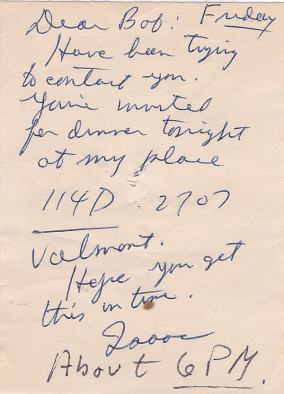
In this process of getting light I have been sorting out old boxes and finding things I haven’t seen in many, many years. Recently I found this note, and the memories and feelings it brought forth are indescribable.

Isaac Horowitz note for dinnerIt marks the beginning of a great friendship. I found the note tucked into my screen door when I got home that Friday afternoon. That night I enjoyed a meal cooked together by two lovely people, and we shared a bottle of wine and talked about wonderful, serious, and enchanting things late into the night, and laughed a lot.

In the summer of 1980 I was living in Boulder, Colorado and one day while riding near the University of Colorado campus I pulled my motorcycle over to see if an older fellow beside the road with a flat bicycle tire needed any help. I later learned he was 60. It gives me pause to think that I am 6 years older than that now.

He told me he didn’t have a patch kit with him. I said I’d be happy to give him a ride, so he chained his bike to a nearby traffic sign and I gave him a ride home on my motorcycle to get a patch kit he had there.

When we arrived the first thing we got was a serious talking to from his friend Gloria, who had been waiting for him and was worried when he hadn’t gotten home as expected and then became quite alarmed when she learned that he had been riding around town on a motorcycle driven by a stranger. She dressed us down like a couple of misbehaving children.

She informed me in no uncertain terms – and reminded him in the bargain – that he was a world-renown physicist blessed with a gift to the world and made it very clear that in her opinion the risk we took was unpardonable. I protested that I let him wear my helmet and that I had been very careful while riding with him, but she was having none of it. It was one of the old “Captain America” helmets, and I think he got a real kick out of wearing it.

Gloria wouldn’t let us go back to the bicycle on the motorcycle then, but she had to be somewhere and after she left we laughed about it and went back with the patch kit. We were naughty boys.

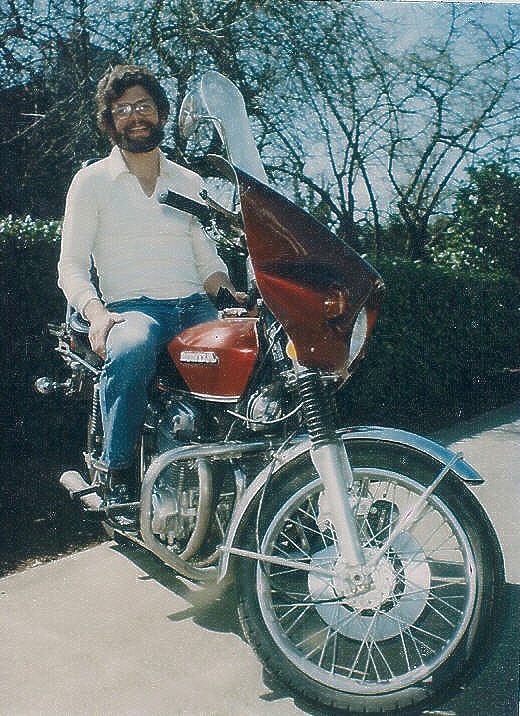
Bob's Honda K4 Motorcycle 1980 EnhancedWe all became friends, but whenever he wanted a ride on the motorcycle he had to sneak out to do it. Later Gloria explained to me again that my new friend was the “Einstein of his generation.” She claimed her reaction about the motorcycle ride was purely protective on those grounds alone, but it was easy to see the real reason for her protectiveness was that she was in love with him.

They had met as members of an international folk dancing group at the University and become friends. It became one of those rare, good, honest friendships that had grown into a deep love between the two of them.

Many of the personal conversations he and I had that summer inevitably turned to the problems his love for Gloria had introduced into his life. We talked about many other things as well. He told me what it was like to ride on the Oriental Express, and I loved hearing about that. At the time I’d taken a passing interest in Synectics, a problem-solving methodology for R&D think tanks that was the flavor of the day, and we had some interesting talks about that. There were some great conversations about history and literature and philosophy, too. We became great friends, and so it was natural that our conversations began to often drift into considerations of what he was going to do about his feelings for Gloria and the sense of obligation and duty he felt toward his family in Israel.

He was deeply conflicted and having a lot of difficulty finding his way. His first marriage had become a marriage in name only, his children were grown or nearly so, and while he had not sought love and had decided to accept his circumstances as they were, love had nevertheless found him out in Gloria. Now it confronted him with choices he had never thought he would have to make.

In one of the last conversations we had before I left Boulder he asked me what I thought he should do. I told him I couldn’t answer that question for him. I reminded him of who he was by telling him about what I had learned about him. He was an honest, loving, caring person, full of an uncommon vitality and love of life. I told him that I’d learned enough about him to know that he already had the answer to his question inside of him, and I knew it was the right answer because he was who he was.

When I left Boulder late that summer and went to say goodbye he invited me to visit him in Israel, where he would be in the fall. I was interested in the kibbutz lifestyle at that time, and thought it might be a good idea. He made sure I could remember his address before we parted, and it was indeed unforgettable: “Just go to Rehovot, Israel and tell whoever you meet in the street there that you want to see me at the Weizmann Institute, and they will bring you to me.” Heck of an address. It turned out he WAS the Einstein of his generation – or one of them, anyway.

His name was Isaac Horowitz. I didn’t go to Israel that fall. Sometimes I wish I had.

A couple of years ago I thought about Isaac and wondered if perhaps it wasn’t time to finally take him up on his offer to visit him in Israel. I looked him up on Google and learned he had passed away in 2005. I also found this item among the remembrances of his passing: “He is survived by two children, Matanya and Benyakir, with Mrs. Gloria August…

He found his way.

I count Isaac as one of the few true friends I’ve made in this life. In one memorial of him he was described as “…An essential singularity in the complex domain of control theory.” I certainly agree with the part about Isaac being an essential singularity. He was my friend, and that describes perfectly his place in my own life and memory.

Isaac Horowitz

 Isaac M. Horowitz (1920–2005)
1948–1950 Lieutenant, Chemed Scientific Unit, Israel Defense Forces

 Isaac joined the Electrical Engineering Department at the University of Colorado, Boulder in 1967 and remained a member of the faculty until 1985. Without leaving the University of Colorado, in 1969 Professor Horowitz was attracted to the Cohen Chair of Applied Mathematics at the Weizmann Institute of Science in Israel, where he remained until becoming Emeritus Professor in 1985.

Professor Horowitz taught a number of younger people who actively participated in developing QFT and published their results together with Professor Horowitz and individually. Over one half of his journal papers (52) were published during the period of 1969–1985. The first in this group of students was Dr Marcel Sidi, who sometime around 1970 suggested to move the plant ‘uncertainty’ from the arithmetic complex plane (as in the book of 1963) to the logarithmic complex plane (this is called Nichols chart when the constant L/(1+L) lines are indicated). This may be the rather small but significant step that made Horowitz’s way accessible to mere mortals. One should also mention another influential student of Horowitz, Professor Oded Yaniv, whose publications and teaching of QFT have had a strong impact on many who were not fortunate to have studied directly from Horowitz.

See more at: http://onlinelibrary.wiley.com/doi/10.1002/rnc.1110/pdf

***

Remembrances of Isaac

Daughter Sharon Feinberg
My father was a tremendous reader, lover of poetry and classical literature, and an avid student of Jewish history. He did not waste time and was always immersed in some sort of activity, often reading. He had an unparalleled physical stamina and energy. A perfect illustration is the following story. Four years ago, at the age of 81, he came to Los Angeles with us. Shortly after he arrived, he borrowed a bike, rolled up his pant legs, and rode off for three hours in the hilly terrain. He appreciated nature, had artistic talent, and drew quite well. He was tremendously responsive to injustice and to the plight of  suffering people, in particular, his Jewish brothers and sisters. During World War II, while most of American and Canadian Jews were silent, he wrote and disseminated a paper crying out against the Holocaust. During the 1960s, when the fate of Russian Jews had not yet become of worldwide interest, my father was actively immersed in this cause, spending virtually all of his free time trying to make a difference. He had a great love of music, particularly folk music. As kids, vacations were usually a week at places like Yosemite National Park. My father was a brilliant man, always open to new ideas and new ways of looking at things. In a sense, he was childlike and very naïve, which helps explain his great love for children, who in turn always loved him.

***

 Wife Gloria August
Isaac and I met 25 years ago at the University of Colorado, Boulder, while I was researching Soviet Jewry. Isaac was involved in getting Jews out of the Soviet Union in  the early 1970s in several ways, including hunger strikes here and in Israel. He also  worked to get Jews out of Ethiopia. Isaac had a strong Zionistic predisposition early on in  his life; he was part of a group who sailed from Marseilles, France, to Palestine in 1948 to assist the young state of Israel. At all times, he was a man of honor and integrity and fought the bigotry and prejudice of his country and the outside world. A month before he died, we went together to a Marine Corps recruiting agency in Colorado. Isaac was so humbled by the American people and their sacrifices. He believed that the United States afforded the Jews the best chance for freedom for Israel. As with his technical work, he was not merely a thinker but a doer. He followed, as I like to say, in the shadows of the famous French historian Marc Bloch (a victim of Nazism), who never sat in his ivory tower alone but pushed to be a part of the history of his time.

Posted in Wandering Thoughts | 1 Comment

2015 – Getting Light in this Life Part 2

I’m getting deeper into the stuff that has come with us to where we are now. It’s like an archaeological dig through my life. In the course of this process I’ve found shards, dust, and a store of pictographs and script and various totems marking principles and wisdoms learned and mileposts on my path.

There are old plans, documentation, photos and thank you notes from customers of our remodeling company, which we operated for over two decades. Things I couldn’t part with yet include the letters from people we served, expressing appreciation and in several cases more than that – expressions of friendship, and gratitude for who we are and how we live.

I came across several hand-drawn residential remodeling addition project plans which seemed beyond me – but I know I really did do them. I was – and am – a builder of things, and I give it my all, and it’s good to remember that from time to time, so I kept three of the plans. I also kept some photos of jobs in progress and after they were complete. The projects themselves are our legacy to our area, and the quality of life enhancements they created in the homes of others are generally still in service today, serving others.

The photographs are a real weight right now, there are so many of them! The next step there is to sort them according to where they belong, mostly to family members. After that I will cull chaff and duplicates, then sort them chronologically, and file them – although why I really don’t know, other than that when I am gone I think it would be nice if at least one other person spent a little time reviewing the pictorial record of my life. It seems a bit of a conceit, but it’s my conceit and I’m not discomfited in owning it, so that’s the plan for now.

There is also a great stack of art prints, posters, and miscellaneous visual arts as well as a large collection of frames to deal with. That will come soon.

What’s proven to be a wonderful part of this process is coming across things I haven’t seen in years. I haven’t gone too deep, but I have old archives of things I saved other than photographs. Notes, newspaper clippings, cards – each with a memory, some marking a lesson learned, a friend made, a wisdom found.  Here are a couple of clipped cartoons that I found on the top of a pile of collected scraps I took out and have on my desk right now.

 ***He could talk when I got him

I originally clipped this cartoon because the parrot reminded me of how I felt in a relationship that lasted about a year. Eventually I flew out a window and was able to speak again. It also reminded me of what happens to us as children when the mechanisms of our social order begin to inform us of who and what we should be, and how and where, and how those influences tend to “cure” us of being who we really are and living and speaking that.

***

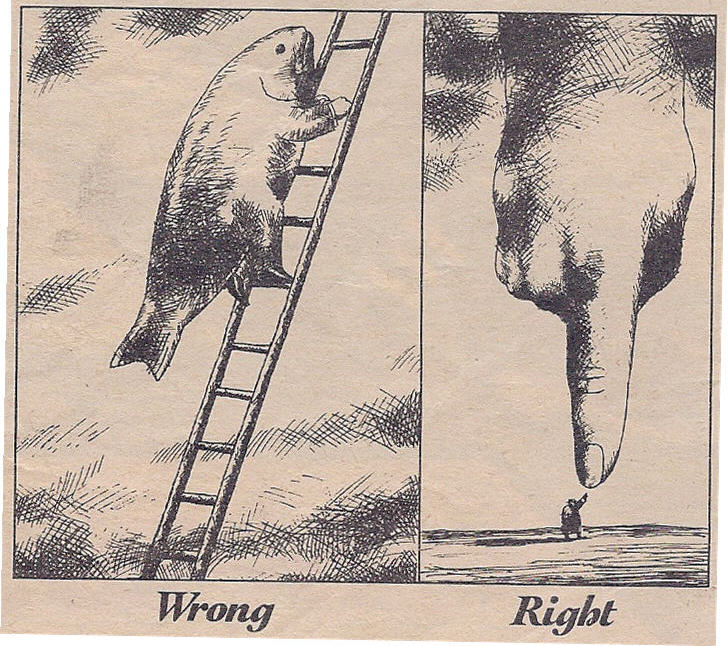
Right and Wrong

This cartoon is related to the first for me, although upon seeing it again I suppose it could also be taken as a conservative Christian statement about the sentiments which espouse the wrongness of the theory of evolution. I took it as a way of saying that – for me – dressing up myself, or the bumper of my car, in the sign of a fish, and wearing that costume to climb up to heaven using the ladder of a religious organization doesn’t work. What works is simply staying in touch with that thing which is simultaneously larger than myself, and is me; God, Nature, The Tao, The Universe, Creation, Humanity, and so forth.

More to come.

Posted in Wandering Thoughts | Leave a comment

2015 – Getting Light in this Life

In the wake of a trip involving the relocation of elderly family members who lived in the same house for 57 years and the realization of how much … stuff… adheres to us as we live our lives, I’ve decided to get serious about an on-again off-again determination Lenore and I share to “get light” – that is, to begin to get rid of at least part of the accumulation of things which for one reason or another have arrived with us here where we are now.

I’ve been culling my library of late and had a rather odd realization. I realized that my assumption that my books would be a record of interest to others, and would serve to inform them of the nature of life in general and provide them with valuable insights into my life in particular, was an illusion.

Actually they will do nothing of the sort. People have their own lives to live, and whether now or later they might come into contact with mine it will be a momentary thing, a brief encounter at best and most likely a quick brushing past, a glancing collision occurring on their own path as they move along there.

I always thought that my library would be where others, seeking to know me better and remember who I was, would go after I was dead and gone. I also thought that I might bequeath it to the child or grandchild I considered most able to benefit from it. Folly, all folly.

My library is mine, and it begins and ends there. This realization – knowing that my life is my life and the record of my coming and living and going is only mine, as temporary and briefly transitory as I am – is a relief to me. I am lighter by the weight of a certain amount of undetected self importance suddenly come into the light and quickly evaporated there.

My essential library has proven to be a collection of place markers of memory, specific to my unique experience. The books are of two types. There are books which were part of my nurture, an input of knowledge which formed my local perspective. And there are books which had the greater effect of resonating in my true nature, books which rang the internal bells of truth and essence for me.

The upshot of it all being that, since my library is mine and mine alone, I have decided to arrange my books chronologically, in the order of when I first encountered them, rather than by genre, topic or category. In doing so I’ve been reminded yet again that I’ve always felt the best place to be is here and now. The timeline revealed in the emerging re-ordering of my library marks several times in my life when I ended one path and began another, entering a new present and going forward without  looking back.

It’s oddly comforting. It reminds me that I have been a seeker and a learner and was never stopped or compromised or resigned to dead ends or defeated by the weight of miseries. I moved always forward until I found my answers, my joy, and love and friendship, and the meaning of life. And like my library, those things are particularly and essentially mine even though I share them with other souls here present as well as those souls who have gone before and are now long dead. I will be dead, too, and yet I am not looking to that any more than I am looking at the past. I am here, now, and that’s enough for me.

In this process of getting light I’m discovering what I value most, and the increase in clarity which comes as some of the extra stuff in my immediate surroundings is cleared away is very enjoyable. It’s nice to see clearly what I do value about my life, and I can see that in the things I choose to keep, or am unable to let go of yet.

For now, although I sense that it will not be forever and perhaps not even for very long, there are some things I could not get rid of right now. Their days are numbered, and should it happen that a ruthless divestiture of most of these worldly belongings became necessary they would not survive the cut.

My tools stay for now because they define a part of me, and also because I know too much about how a house is built and how to fix things in ours should something go wrong, and because for some unknown time into the future my body will still be able to use tools to do so, and make whatever thing my whimsy might inspire.

There are some photographs which I will keep for now. There are many I will send to others because it seems to me they belong there, not here. Of the ones I keep for now there are only a few I will keep to me for as long as I live. I have many treasured pictures of Lenore, and some pictures of children and dogs I have known and loved – curiously part of the same category, it seems – and a few pictures of the places, and personas, I have been. Those will stay.

I will keep most of the books I have read, arranged chronologically for the personal pleasure the arrangement affords me, but I am getting rid of all the books I have read for light entertainment, and the ones I have meant to read, or tried to read, but which have not for whatever reason engaged me. They had their chance with me and I with them.

For now every pleasing knick knack stays. I could not find one I didn’t like. Each is an artful marker of memory, more so even than my books. The leaded crystal bookends which belonged to my father, the old brass Proteus barometer which came to me from a friend and old soul, all the small and artful things made of candle wax and porcelain and glass and brass and copper and iron and crystal minerals and wood – all stay. So do all the plants. They are mine, they are ours, they mark our time and our lives for us. When we are gone then they will go too, never to be arranged in this way again. But not until then.

One thing which will go before I do is my writing. All of it. I plan to remove all traces of my identity from everything I have written. I will then copy it all onto a small thumb drive, wipe my hard drive clean, put the thumb drive in a bottle, and arrange to have it dropped into the middle of the Pacific Ocean without a cork in the bottle. From there it may go where it will. That thought amuses me. I think it will sink. And I’m almost certain I hope it sinks, but the remainder of uncertainty I have about whether or not I really want that to happen seems to make the bottle drop necessary, at least for now.

I always wondered about the cowboy who, about to die, shot his horse and burned his saddle, thus obliterating his entire estate on the way out of this life. I think I understand him now, at least partly, although in my life the horse lives and only the paperwork with my name on it burns, and the saddle goes to the country thrift store.

What that cowboy meant to do is leave not a trace of himself behind, because he knew that’s the way it is. Our life is our own, and no one else’s, and only here and now, and only for as long as we have it, and we only live in that brief time, and only then can we share it with anyone.

You have to remember what comes after this life could be anything, but it won’t be this. Best live it here, and now.

Posted in Wandering Thoughts | Leave a comment

Terrorized by Politics

In observance of the current election cycle I have taken some time to go back through my archives here, to review what I have felt and expressed in the past about politics. Thought I’d share them here, for what they are worth to the person wandering by.

We Carry On The Work Of Our Heroes
(Published January, 2002)

2001. It was a full year, landmarked for all by one day.  On Christmas Day of that year I watched a rerun of one of the musical concert benefits for New York City. Names were read, pictures displayed, family and friends and co-workers spoke in remembrance of lost ones. There was grieving, and celebration, and through it all the tumbling, churning chaos of coming to terms with the unthinkable, the unbearable, the implacable.

One face will never leave me.  He was ten years old, strong and healthy and clean and bright, flushed with the celebration of the event. He stood on stage in Madison Square Garden before a microphone, in the spotlight. The strong hand of a huge friend rested on his shoulder. When he spoke, he held up a picture, and he said, “This is my father. He’s a hero, and I love him.” When he spoke there was an instant when the terrible grief of his loss flashed across his face. Just an instant. A lightning bolt. When he took the hit, it broke my heart.

We all need heroes. And when they leave us, it’s a terrible thing.  We remember their acts of selfless, loving, sacrificing devotion.  We carry the seeds they planted, and we go on. But there’s a hard fact here. The acts of dead heroes are completed. From them we will have no more. Their deeds are done; their legacy given. What happens next?

In his poem “Out, Out”, Robert Frost describes what happens next for the rest of us:

“… And they, since they / Were not the one dead, turned to their affairs.”

It’s true.  We do.  We go on, we turn to our own affairs.  For many there will be a return to mundanity. The awe and glory will fade, the gained perspective will disappear with distance. Time will not carry them forward. They will fall backward into themselves, buried in the small matters of their own ego-business.

Some of us will go forward.  The legacy bequeathed us on September 11, 2001 is engraved on our hearts. We will not leave it behind because we can’t. We will turn to our affairs, and for us those affairs have changed. Abraham Lincoln said it very clearly: “It is for us the living rather to be dedicated here to the unfinished work which they who fought here have thus far so nobly advanced…”

That is what happens next. New heroes step forward. They come forth as guardians, mentors, advocates, benefactors, allies. They stand firm, give time, extend love.  Self-sacrifice embodies their being. They advance the unfinished work.  They point the way.  Most of us acknowledge and honor the help, guidance and inspiration given by such people to our own lives. Now we are acutely aware of their acts on our behalf. Now we are clear that it is our turn to advance their work.

The image of that 10 year-old boy who lost his father, his hero, is burned indelibly into my heart. There is a hand on that young man’s shoulder.  It’s the hand of a hero, dedicated to the unfinished work.

Journalism 101

A free press is charged with the privilege and grave responsibility to inform the people without the prejudice of malicious “spin” from any quarter. The privilege is granted; is the responsibility being met?

Prejudicial spin is overwhelmingly evident in the deeds of much of our media, and by their deeds we know them. We behold the raving minority, the bizarre, the horrible. It’s a snapshot view circumscribed and shaded with the agendas of unenlightened self-interest driven by politics, circulation and viewership share, and just plain laziness; a seemingly inexorable migration toward the cheap and easy attention-grabbing techniques of tabloid journalism.

The neo-media devolution from thinking mind (Edward R. Murrow, Walter Cronkite) to talking head (reads well, looks good) to self-inflated screaming face (take your pick) and sensational antagonism is a movement from the sublime to the ridiculous, a fall from the grace and grandeur of traditional journalism into a stinking, self-made tar-pit of guaranteed extinction.

The principles of Journalism 101 are not presented first because they are easy. It’s because they are basic. They’re vital, hard-earned, proven facts with the weight of a successful history behind them. The best journalists in the world exist and thrive on this basic foundation. Who, what, when, where, how. Be careful of “why.” Report fact, not judgment, opinion or hearsay. Reportage first, last and always. Personal opinion is counter-productive, weakens the piece, limits your audience, obscures the facts with emotion. It’s a given that the reader/viewer will draw their own conclusions. Make sure your part is a simple, complete, concise delivery of the facts. Do that and you live up to the standards of integrity necessary to the continuing life of a free press. Fail, and you deprive yourself and everyone else of a vital, precious necessity; the unvarnished, unadorned truth.

There’s always been a target-rich environment for the serious investigative journalist willing to take the time to light a candle and keep it burning rather than  blowing away the lights of others. The newsworthy item of the moment too often yields only a momentary worth. The legitimate story crying to be told in depth is lost in the rush to form the next 30-second sound bit, or the next miniscule capsule of column-inches.

We don’t see much of fact-based reportage, bracketed by sidebars of opinion where they belong. We get it all in one short burst; the fact, the fancy, the judgment and execution, the short and saccharine sweet of it… next!

If the attention span of Americans is no longer than that of their favorite channel, and their conclusions are formed and forged from the materials given them, what then would be the remedy to the partially informed instant opinion (i.e., ignorance), and where would it start? The answer is obvious. More information. Less opinion.

In other countries public opinion is formed no more and no less by the same means as our own; through the public media. That those opinions diverge so violently is a testament to the overwhelming presence of slanted reportage in media. When Spin is King the truth goes begging, and humanity throngs blindly down to war.

Information lends understanding. If we are to comprehend issues, all the facts are necessary to form our conclusions. Opinions are optional in this exercise, and often fog the view. But if we have the means to comprehend the full picture, then we can go one better – we can apprehend it; we can actually “get it”, can capture the fact and use it to form an informed opinion that finally has a root in reality rather than the emotional or political flavor-of-the-day.

I challenge all who are in the profession of journalism to search at length and depth and find and report only the facts, and strive to keep a complete and objective view of fact constantly and readily available to the public eye. Our ability to see clearly depends on you. Those of you who accomplish this will become the very best of us, and we will owe you a great debt.

If you want to earn your place in journalism, remember this: Fact is fact. Emotion is mere fancy. It’s your choice and constant challenge to represent one or the other. Your decisions will determine your integrity, your quality, and ultimately your professional life or death.

It’s simple to fall to the level of what we oppose. It requires constant vigilance and the occasionally embarrassing admission of misguided fervor. A biased emotional rant is cheap and easy. It gives the greatest effect for the least effort. In the streets or in the press, it damages everyone. And who gets damaged is surprising. Fire in anger and without thought and usually you shoot yourself in the foot. A toe count before the next salvo by anyone is always wise.

My Burger. My Way.

A growing syndrome is being acted out in America these days. It’s a sense of entitlement insisting that we have an inalienable right to have things our way, right now, guaranteed and unquestioned.

Is the fault in our stars or in ourselves? Are we at the mercy of events and powers greater than ourselves, unwilling and ever-angrier victims of fate, persons and processes that we can’t control? Or is the fault more personal and more painful?

American freedoms and diversity of belief have coexisted for nearly 250 years. A spirited discourse has resounded back and forth over issues of belief, policy, law. What is remarkable now is that beneath the discourse there is widespread anger, and despair. There’s a growing willingness to use “spin”, bellicose posturing, and blanket condemnation absent of fact, reason or constructive solutions.

In January, 2002 in The Columbian newspaper of Vancouver, WA I wrote: “…. The legacy bequeathed us on September 11, 2001 is engraved on our hearts. We will not leave it behind because we can’t. We go on, we turn to our own affairs. For some there will be a return to mundanity. The awe and glory will fade, the gained perspective will disappear with distance. Time will not carry them forward. They will fall backward into themselves, buried in the small matters of their own ego-business… Most of us will go forward.”

If I were in hindsight to change the wording of that article I would change only two words. I would exchange the places of the words “some” and “most”. The rest of it remains as true today as then.

In that article I predicted that new heroes would step forward, coming as guardians, mentors, advocates, benefactors, and allies to stand firm, give time, extend love, and advance the unfinished work. They have. They are where they have always been, quietly doing what needs to be done.

They are not lost. They are not the policy of the moment, they are not the transient media-flavor-of-the-day. They are friends, family, neighbors and comrades, taking care of one another and conducting themselves honorably. They advocate with reason, offer hope and constructive solutions, extend their compassion to others. In war they fight for the survival of their comrades and honor their personal commitment to serve when called, regardless of the policies that have placed them in harm’s way. If their trust is betrayed by their leadership they will speak out. But first they will protect and defend and serve others where they are, now. They are our true leaders.

If we find ourselves fallen backward into our own small ego-business, suffering from anger and despair, there is a way out. We can pick ourselves up. We can follow our true leaders.

The State of the Union is Dark

Authors note: This article proved prescient. Or it at least proved that if a person chooses to notice, investigate and verify what is going on, that person will at some time in the future appear to be prescient, even though the truth is they were only paying attention to the obvious rather than choosing to remain ignorant of it. It was written a year after the 2004 election cycle and before the worst of the cascade of events which occurred during the second term of the administration of George W. Bush.
 

The state of the Union is dark. I think of the German population slowly seduced by Hitler. People who didn’t have the time or memory or desire to see things as they developed, who didn’t have the guts to stand up. I think of the Roman republic, collapsed in 476 AD by vultures glutting themselves in the final hemorrhagic flow of an empire, the death by a thousand cuts which always starts with a single cut in which a few dip their beaks. And I think of the administration of George W. Bush, those lean and hungry grinning hounds taking America down.

The facts are in now. It’s a disturbing record far too long for this space. If you still employ a stock of culture war retorts and rationales as a response, spare me. The record is clear. Spin will still obscure the view of the gullible, the ignorant, the mindlessly trusting. But it will not change fact. America is down, and struggling.

I pity the Americans who have given their vote to this administration twice, but I do not sympathize with them. They are getting what they deserve. They voted for an illusion, a  moral-values puppet-emperor parading unclothed save for a veneer of self-righteous piety. Now they are in debt and uncared for, at war and at risk, a blithe herd cozened into a valley of death.

I don’t think the political pendulum will swing back and save them this time. It’s over weighted. The momentum of a final overwhelming plague of leeches is carrying it through the walls built by the Declaration of Independence, the Bill of Rights, The Constitution.

My gut says it’s time to duck and cover. Iceland is melting, big oil is in power, Kyoto is just a city somewhere, New Orleans is awaiting the final, killing blow. Grandpa is taking his shoes off at the airport and subject to indefinite detention without benefit of habeas corpus. The marching, charging feet of religious zealots at home and abroad are calling down holy wars in the name of God, life and family values. Voters keep pork feeders in office for a pittance of bacon scraps while their too-oft re-elected representatives dine grandly on ham and ribs and chops. The once-thoughtful mind of the media has morphed beyond a talking head and is now a screaming face. A pitiful, anxious, self-conscious sneer adorns the face of our leader, a man fed and cared for by sycophants and suck-ups, a simpleton who reads poorly and has proven himself  an easy victim of well-practiced liars and swindlers.

Time to go. Time to stockpile rice and beans and pedal-driven generator parts in a wilderness homestead. I’ve never felt this way before, even during Nixon’s tenure. That was horrifying, but people were fighting hard for America back then. Nixon was an amateur, a transparent fumbler. These guys today, they’re good. A lot of people don’t see a thing, don’t feel a thing. They just wonder as they go down: whose blood is that?

Hope

What is there here, now, in our very real world, that gives us hope?  The desperation for hope—for our future, for the planet, for a “new paradigm” of humanity—is evident everywhere, engendered by an ever-widening feeling of imminent doom.

Hope grows as doom approaches; it is an axiom of humanity. Is that generalized feeling of approaching doom merely a feeling? It appears to be real. Our grasp at hope is attempted but not achieved by contemporary wisdom. The onrushing prospect of an end to things is everywhere proven by arguments striving mightily to prove the contrary, ever more urgent, ever more strident as more alarms go off and the soon-to-be-stricken fight for purchase on a slippery and steepening slope.

Will God destroy us as yet another errant culture and seed a new one with the righteous remnant of the old? Stated in the classical idiom, that appears to be the rest of the story. The holistic record of spiritual, social, cultural and political histories tell us it is so. As it was, so shall it ever be, and so amen. The fatalism is disturbing, the record unassailable, the conclusion unavoidable and perhaps foregone.

There is much thrashing about and gnashing of teeth as our pundits, our scholars, our priests and our political leaders consider the brink of our cataclysmic demise. It’s an approach marked by sudden flashes of awareness and interludes of dark denial. “New paradigms” are speculatively advanced even as the old paradigms advance upon us like a conquering army.

Will Homo sapiens be saved in the nick of time by the recent advent of homo superior? Creative, global processors are appearing on the human evolutionary timeline, exhibiting extraordinary capabilities. They examine current events and accurately predict the future.  They see, and then they know.

They are the prophets of our generation, the seedling apostles planted in the decay of a culture veering into the Lucifer paradigm, the oldest fatal path since the beginning of self-will and choice.

It has nothing to do with religion or politics. It has to do with the basic principles bearing on individual human choices which collectively sum up to deliverance or damnation on every cosmic scale from the mote to the whole, from the individual to the universal collective.

If there is hope, it is not in the collective cultural sum of our individual choices to date, for which payment is soon coming due. Collection will not be postponed when we protest the debt, saying we did not choose this, that the choice was made by others in our stead or absence. Our complacency and accommodation, our rationales of unconcern and non-participation; in short, our self-focussed pursuit of selfish goals and dispensations at the cost of others will be bitter as wormwood to us as we fall to the double-edged sword of choice and karmic return.

There is salvation here, but it is not the salvation we want.  It is the salvation we need.  The new paradigm is here; it is the oldest paradigm there is: Choose.

If we remain too proud to humble ourselves before the rules of universal law revealed in the Koran, the Upanishads, the Sutras, the Bible and other sources of light; if we remain benighted with the ego-corruptions of their Truth which manifest as greed and self-interest, first in the person and then in the village, church and state – then darkness will come.

Our survival, individually and/or collectively, will be the result of a clear perception of an ancient, ever-present universal wisdom. When we are conscious and active daily participants serving others with the cooperative respect and concern of love, we will live. If we pursue or even only ignorantly allow selfishness, greed and personal power to rule, then we will fall as Lucifer from heaven, and for the same ancient reason.

No culture has ever resurrected itself from a path of errant choices. A merciless karmic sword has fallen on every one. Yet every culture has been delivered to a new opportunity in the process, a circular evolution back to the beginning, offering new life or recapitulated death with the oldest paradigm: Choose.

It is a verity of consciousness embedded in the atoms, the cells, the multi-cellular. It is in the root of every systemic organization in the Universe. It supports the impulse toward cooperative combination and complex symmetry; it recycles the singular and the asymmetric again and again until the separate atom, cell, system, organization and soul finds its home.

There is no cause for despair here. From the vast cosmic level right down to our individual, personal existence the solution is real, and present, and readily available. If we choose right, we live. If we choose wrong, we suffer and die again and again. In the coming times it will be as it has ever been. Love for others will deliver us from evil; abandonment of others in favor of our own personal appetites for hoarded luxuries beyond our needs will condemn us.

In our own time, as a culture, the sum of hell is achieved when “disposable income” is gained at brutal cost to others. The karmic principle unfailingly returns to the individual and the collective that which they produce. A belief in exclusive prosperity will conduct the believer not to prosperity, but to exclusion.

Salvation is personal. Choose.
Posted in Wandering Thoughts | Leave a comment

Christians and Prosperity Doctrines

Six years or so ago I wrote an article for an online community which was published in February, 2008 about Christians and the Question of Riches. I recalled doing so while reading about Chapter 67 of the Tao Te Ching at Ralston Creek Review and the very useful observations in the commentary there, particularly Louis’ comment about “law of attraction gurus” who ply their wares in the broad stream of media bandwidth. Thought I’d reprise it here, considering it covers the ground from yet another angle of perspective concerning humility, frugality, and compassion.

Christians and the Question of Riches

The riches offered by contemporary prosperity doctrines bring us to a critical question. Can we follow Christ and also focus our personal attention on gaining financial security and material wealth?

Jesus speaks of spiritual riches. Riches of wisdom, knowledge, forgiveness, compassion, caring, faith, love, humility, meekness, patience, self-denial and giving. He asserts that no one can serve God and wealth, or mammon, because it divides our attention.

Yet contemporary prosperity doctrines often feature the gain of worldly riches and material wealth as guaranteed rewards for the faithful. It’s a proven hot ticket, a big draw for mega-churches and televangelists. The essential principle – richness of spirit and treasure in heaven – is rarely glimpsed amid the blare and glare of this latest gold rush, where fervently whipped air promises the congregation more, more, more, available here and now, if only they buy the device being sold there.

The sales persons here are often deeply earnest about the message they deliver. If during their journey from the source to the recipient they have become errant or diverted from the real message, it is not simply a matter of assigning blame to them for the jumble they deliver. In this instance the recipient shares responsibility for what they hear and what they buy. They do not listen for truth, and so do not hear what they need. They listen for what they want, and when they hear it, they buy it.

What do they buy? The handy-dandy, one-size-fits-all, install-it-yourself Handle On God. The sales pitch goes something like this:

“Get a grip with the H.O.G.! Be in total control 24/7! Haul God around like a satchel and use him when you need him. Make God your personal grab bag, a cornucopia of fulfilled desires. Wield him against your enemies like a sock full of bricks! Includes all instructions on how to hold your mouth just right, control your thoughts, force the universe to deliver your every want, gain total control over everything, and look good doing it.”

That’s the general pitch and tone of the thing. And in the fine print, clearly viewable through either any world-class electron microscope or a mere iota of discernment, is the following disclaimer and side-effect warning: “The HOG system includes (1) first-class ticket on the generously greased express slide to despair, anger, embarrassment – and possibly hell – at no extra charge.”

If that’s what you’re saying or hearing, it might be time to reconsider a few things. Matthew 6:24-33, the passage that begins with the observation about love of mammon and then proceeds to inform us to take no thought about what we will eat, drink or wear – and to only remember where it will come from – ends with this: “seek ye first the kingdom of God, and his righteousness; and all these things shall be added unto you.”

This is the root of truth behind prosperity doctrine. It is repeated in Luke 6: 37-38. “Judge not, and ye shall not be judged: condemn not, and ye shall not be condemned: forgive, and ye shall be forgiven: Give, and it shall be given unto you; good measure, pressed down, and shaken together, and running over, shall men give into your bosom. For with the same measure that ye mete withal it shall be measured to you again.”

In this passage giving and receiving are simultaneous events, not cause and effect, or a sanctified work-for-pay arrangement. Think about that. There’s quite a difference there. It’s the difference between true riches of the spirit and the desperate poverty of a fearful heart which has forgotten how to trust and be loved. It’s the difference between a tithe released in joy to seed and grow, and a tithe meanly spent for mere return.

Our time appears unusually challenging to us, more so than the times of past generations. We are confronted by economic instability, political terror, moral laxity and dissolution. Insecurities and fears come at us from every angle. But they are not special. They are the same ancient challenges all of humanity has had to confront in every generation. Fear erodes faith. Humility is easily lost and too often an arrogant self-righteousness rises from its ashes. Confronted with fear and instability we desperately crave the stability faith offers, yet we look for answers in the world.

The riches of Christ and Christianity are riches of the heart and spirit. There is nothing in the world that can meet that measure of wealth. The feeling of poverty is the wage paid when we believe we have less and begin to chase after more. Prosperity is about remembering that what we have is enough, and reminding ourselves of the riches we have already received and given, and giving more of the same. Those are good things to remember when we feel poor.

Posted in The Cascadian Wanderer | Leave a comment