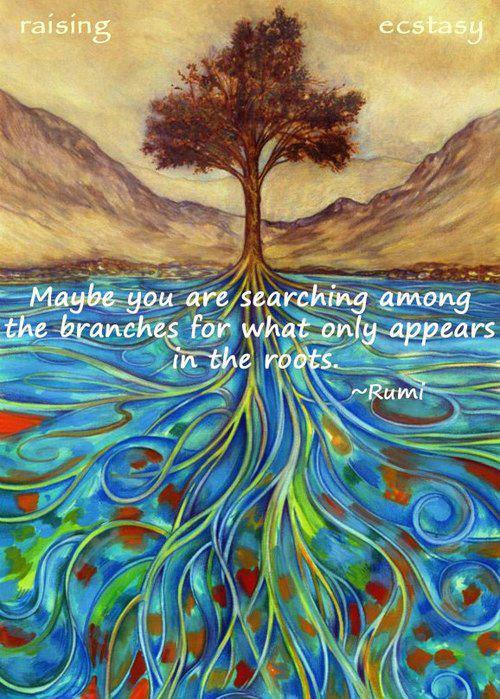
Tao Te Ching Chapter 5

 1. But for heaven and earth’s humaneness, the ten thousand things are straw dogs. But for the holy man’s humaneness, the hundred families are straw dogs.2. Is not the space between heaven and earth like unto a bellows? It is empty; yet it collapses not. It moves, and more and more comes forth. [But]

3. “How soon exhausted is a gossip’s fulsome talk!

And should we not prefer
On the middle path to walk?”

Translated by D. T. Suzuki & Paul Carus, 1880

Heaven and earth are not humane:

The 10,000 things are straw dogs to them.
Sages are not humane:
People are straw dogs to them.

Yet heaven and earth
And all the space between are like a bellows:
Empty and inexhaustible,
Always producing more.

Longwinded speech is exhausting.
Better to stay centered.

.

Translation unknown; found athttp://ralstoncreekreview.com/chapter-5-straw-dogs-2/#more-515

Mindwords and Roots

Translations really do prove that words don’t cut it. Part of my spiritual practice is to take what I need and leave the rest, knowing it will come back around or evaporate. I have been through several translations of this chapter and it became evident to me that each reflected the eye, ear and sensibility of the translator – and in the case of this chapter those perceptions seemed to vary widely, and even conflict, as evidenced in the first lines of the above two works.

I will follow the same path here and provide my own “fulsome talk” and “longwinded speech” until I am exhausted and remember it is better to walk centered on the middle path in silence, to walk in the breath of Heaven and Earth.

Tao Te Ching, Chapter 5  (Reflected)

Heaven and Earth are One. Nothing is between them.

Heaven and Earth breathe, and ten thousand living things come forth.

Everything is in the living breath of Heaven and Earth.

The ten thousand things mean nothing to Heaven and Earth.

It is breath. It is living.

It has no meaning.

It is Being.

Humanity sees meaning in ten thousand things.

Humanity builds ten thousand inanimate facsimiles of Being.

An idol of clay and straw, a golden calf, a crown of words.

Humanity forgets to breathe with Heaven and Earth.

The sage knows this.

There is nothing between Heaven and Earth.

Walk, don’t talk.

Breathe. 

And laugh, too. Laughing is a sort of “speed breathing” as far as I can tell.

Posted in Tao Te Ching | Leave a comment

Tao Te Ching Chapter 4

The Tao is an empty vessel; it is used, but never filled.

Oh, unfathomable source of ten thousand things!
Blunt the sharpness,
Untangle the knot,
Soften the glare,
Merge with dust.
Oh, hidden deep but ever present!
I do not know from whence it comes.
It is the forefather of the gods.

Is the glass half full or half empty?

If a tree falls in the forest and no-one hears it does it make a sound?

What is here if you are not? That’s the Tao.

If you’re here:

The glass is half full, or the glass is half empty, or, as you expand, the glass is full of air, and water, and light –  and you. The sound is shared.

If you’re not here:

Earth, air, fire, water. Life. Whole and holy emptiness.


2 Responses to Tao Te Ching Chapter 4
  1. Tao is everything, and nothing. I love this. Would you like to write a post for my blog? It would be fun. You can pick whatever you want – I am sure you would come up with something good.

    • bobgriffith says:

      I’d like that, Amy. Your faith that it will be something good brings a breath of inspiration here. I will breathe it in, and together we’ll see what transpires!

Posted in Tao Te Ching | Leave a comment

Tao Te Ching Chapter 3

Translated by D. T. Suzuki & Paul Carus, 1880

Translated by Jane English & Gia-fu Feng, 1989

KEEPING THE PEOPLE QUIET.1. Not boasting of one’s worth forestalls people’s envy.Not prizing treasures difficult to obtain keeps people from committing theft.2. Not contemplating what kindles desire keeps the heart unconfused.

3. Therefore the holy man when he governs empties the people’s hearts but fills their stomachs. He weakens their ambition but strengthens their bones. Always he keeps the people unsophisticated and without desire. He causes that the crafty do not dare to act. When he acts with non-assertion there is nothing ungoverned.

Not exalting the gifted prevents quarreling. Not collecting treasures prevents stealing. Not seeing desirable things prevents confusion of the heart.The wise therefore rule by emptying hearts and stuffing bellies, by weakening ambitions and strengthening bones.If men lack knowledge and desire, then clever people will not try to interfere.If nothing is done, then all will be well.

I found a nice website that allows side-by-side comparison of several translations, two at a time, of the Tao Te Ching. It’s at http://www.duhtao.com/sidebyside.html

I compared the above Chapter 3 translations by D. T. Suzuki & Paul Carus, and Jane English & Gia-fu Feng. My aim was to avail myself of two interpretations and then bring my own understanding to what was said there, and my reflection will be found below.

The dualistic mind has the option to impute layers, levels and values to what it perceives as the result of experience. Complexity and ten thousand things are the result. The mind sees patterns in the resulting pieces and seeks to restore a reality which was never fractured in the first place until the mind broke it.

The Tao Te Ching can be fractured too. Simplicity serves as well as complexity. Large pieces are easily fit back together; small pieces magnify the illusion of time and distance. Simplicity rises like a rocket toward complexity in the dualistic mind, which seeks simplicity in the complex.

Perhaps it’s simpler than we know. Rather than seek meaning in the nuances of the ten thousand things, can the path simply be about understanding what we already know, and putting it into action in our experience?

¨

 Tao Te Ching Chapter 3 (Reflected)

If worth and gifts are not exalted as being more than or less than, then there is no envy or quarreling.

If there is no value given to material treasure, then there is no desire to steal.

If there is no desire for things, the heart is not confused

Wisdom rules when the heart is empty of the confusions of more than and less than.

Wisdom rules when the heart is empty of desire for treasure.

Wisdom rules when stomachs are full and bones healthy; when the heart is empty of confusion and desire; when there is no value or reward or justification for ambition.

If people are not corrupted by sophistications of desire and knowledge by the sly and crafty, then the sophistications of the greedy have no power.

The one who knows that there is nothing to contend for is not contentious.

If no value is given or present, then no value can be stolen or absent. Everything is in order then, and all is well.

¨

 There is, of course, the obvious socio-political context of the guidance given. I prefer to not take up the offer made by my dualistic mind to fracture the passage into any more nuances than I already have.

For a nicely drawn elucidation of three perceptive levels evident in Chapter 3 to Louis Weltzer, a person who has a deep and insightful interest in the Tao Te Ching, please avail yourself of The Blog at Ralston Creek Review, http://ralstoncreekreview.com/

3 Responses to Tao Te Ching Chapter 3
  1. Louis W. says:

    These are excellent insights, Bob.

    Before commenting, let me mention another website you might find interesting because it has many translations to compare. It ishttp://earlywomenmasters.net/tao/ch_01.html.

    As I read what you have written, I think of Buddha’s Second Noble Truth, which tells us that the cause of suffering is attachment and greed. So much has been written about desire and attachment that I will not try to add anything here.

    I will comment, though, that desire, value and exaltation are all products of our mind and do not arise from the external world of the 10,000 things. The solution to greed and striving and attachment is also within – it is what you have called “wisdom.” That is a good word for it.

    Thank you for this teaching.

    • bobgriffith says:

      You’re welcome, and thank you, Louis. Your comment on the location of the 10,000 things and their relationship to the mind is very helpful. I tend to wander back and forth in the resonance between the two, the place where one reflects the other, the symbiosis there. My clarity drifts between the wavelengths and my expressions get fuzzy, sort of like a distant AM radio station coming in with a thousand miles of static riding the signal.

      It is always good to clearly see and remember the matrix of understanding which applies to this particular path. It was nice to see my blurry light pass through your prism and emerge as a sharp, clear beam.

  2. I love this, Bob. I especially love the two lines about wisdom ruling. Yes, it does!

Posted in Tao Te Ching | Leave a comment

Tao Te Ching Chapter 22

Yield and remain whole
Bend and remain straight
Be low and become filled
Be worn out and become renewed
Have little and receive
Have much and be confused
Therefore the sages hold to the one as an example for the world
Without flaunting themselves – and so are seen clearly
Without presuming themselves – and so are distinguished
Without praising themselves – and so have merit
Without boasting about themselves – and so are lastingBecause they do not contend, the world cannot contend with them
What the ancients called “the one who yields and remains whole”
Were they speaking empty words?
Sincerity becoming whole, and returning to oneself

Derek Lin

Yield and overcome;
Bend and be straight;
Empty and be full;
Wear out and be new;Have little and gain;
Have much and be confused.
Therefore the wise embrace the one
And set an example to all.
Not putting on a display,
They shine forth.
Not justifying themselves,
They are distinguished.
Not boasting,
They receive recognition.
Not bragging,
They never falter.They do not quarrel,
So no one quarrels with them.
Therefore the ancients say, “Yield and overcome.”
Is that an empty saying?
Be really whole,
And all things will come to you.

Jane English and Gia-fu Feng

What conditions need to prevail in order for the ego-mind to become whole, to be connected rather than disconnected from the essence of the One? This chapter covers that and affirms what sages down through the ages have spoken of: the spiritual power of selflessness, of emptying self of the desire to operate exclusively separate rather than be holistically incorporated with the essence of the One.

Transcending the ego, or, more clearly, yielding the desires of the ego to the essence of the One, is simple. The principle is expressed in the oft-misunderstood words of Jesus: “…I speak not of myself: but the Father that dwelleth in me, he doeth the works.” It’s basically about allowing the agency of free will all human beings possess to be open to the essence of being. This is the absolutely fundamental choice we are all called to make in every moment.

Yield and remain whole. Yield and overcome. Have little and receive.

Self will is a tricky thing. It has the power to choose and act. Ideally, the fundamental choice self will makes is the choice to be aware of feedback from higher systems of organization beyond its perceptive locality. It can, however, choose to function from a local perspective. It is then self-centered, self-guided, and self-separated from connections with higher consciousness. My will, not thine, it says. What I know is sufficient, what I have is mine, I have merit, my way is the best way, I am the most important thing, my achievements, my possessions, my status, my ways and means define the universe, my contentious victories have made me supreme, look, see what I have and how I have got it and how I live, listen to me, heed me, follow me, worship me.

In our time we have been brutally made aware that selfish material gain comes at great cost. In America it is particularly hard for the fat camels we have become to pass through the needle’s eye of selflessness and enter the kingdom of the One.

In our nation every mansion creates a thousand hovels, every fortune covetously held for casual and extravagant gratification of the few creates a thousand poverties of roof, bed and bread for the many. No one has enough because only more than enough will do. Fear and pride tell us we must work for ourselves, gain for ourselves, hoard for our own sake, spend for our own sake, withhold from others for our own sake. And besides, we got it ourselves, we have it ourselves, it is ours and ours alone.

Yes, we care about inequity and justice and community; yes, we are compassionate and we deplore the plight of the poor, the aged, the sick, the infirm. We do care. We just care about ourselves more, and our personal perspective and a few judiciously applied rationales sort of, just – you know – conveniently blur and blot out the rest. All of which, when you think about it, really is secondary – and a poor second at that – to ourselves. Our self.

That’s the basic choice. The correct choice of the ego is to yield, to give up its autonomous separation and “specialness” and thus remain whole and connected; to yield and give up acting according to the coercions of fear and desire and so overcome its own limitations of selfishness. It’s a simple choice.

This chapter provides practical advice on how we can do that in terms the ego understands. For ego, the path chosen must have an upside, a benefit, and the information passed along to it in this chapter relays that in terms ego understands.

Want the best possible result? What’s the action which produces the greatest benefit? In this chapter the essence informs the ego in this way:

Yield, bend, be low, be worn out, claim little.
Be assured that in spite of what you see these things to be, the opposite will prevail.
You will remain whole and straight, become filled and renewed, will be given much. Anything you claim to be yours alone will confuse you.

Hold to the essence of the one, letting go of self desires.

If you do so you will not flaunt yourself in order to be seen, you will be seen clearly.

 If you do so you will not flaunt yourself and be presumptuous in order to be distinguished, you will be distinguished by the excellence of the essence conspicuous in you.

 If you do so you will have merit without self praise and self exaltation.
If you do so you will endure and be known and remembered.

If you do so, because you do not contend, the world cannot contend with you.

If you desire to be wholly full, empty yourself,
make room for the essence,
and it will fully fill and fulfill you.
Posted in Tao Te Ching | Leave a comment

Mining The Tropes

Mining The Tropes Of Our Lives For Archetypes

there we were again, inside,
drawn down the narrow shaft of perspective
past mind’s open maw
into the pit of coal and diamonds
where the empty ache of eons rests
above, below, and all around us
in the bones of the ages

there we were again, inside the mind,
mining the tropes of our lives
for archetypes

and blinking at each other
faces blackened with soot
our eyes startled out like headlights
when we remembered
what we left above
for this dark

the light
the breeze
the open field

the leaves of fall
the winter sleep
the green spring
the light summer dresses rippling in the breeze

Posted in The Wandering Doggerel | Leave a comment

Wisdom

Confusions on the Path to Parity of Mind (Part Two)

Wisdom is in the geese flying north in late October evening
above the asphalt-shingled jails of geometry
where the prisoners below,
thumbs screwed, sinews twitching
in the clicks
of buttoned alphabets and numbers,
flare synapses
in screened cages of dark plastic.

Wisdom is in the golden maple unleafing
above the fool in the yard
with his rake and plastic bag
enforcing order like a guard.

Wisdom is in the river in the forest nearby
where the poet, eyes closed to the truth of water,
still at his desk,
stubbornly tortures a word from his mind with his will
and the cozening tip of a plastic quill.

…that night he went to bed, finished a book,
kissed his love
closed his eyes
and found his last prayer done and gone
and in its stead a curse
against the mind

god damn the constructs, god damn the mind
which creates god and glue and order and time
god damn the thing which separates
beginning and end and the time between
 
god damn loss and god damn gain
god damn lonely flesh thrashing in pain
and the manic hundred years
of solitude
seeking heaven’s lost lane end
 in a phantom interlude
and all the canons of literature which catalog the pain
of human desecrations and the merely profane.

Then suddenly the fundament turned upside down
no longer girded by the ancient fret beneath,
no longer the sorting rearrangements
inserted
– click –
into neat cubicles of orderly belief.

awake in the dark he beheld
the matrix of order collapsed,
fallen from proof to hypothesis to naught,
and the ancient thing come up from darkness
fretting for itself.

What will I do? What will I do?
If all the order I constructed is of no use?
How will I know
what is right and wrong,
when day is ended,
when night has come?

What will I pray to, what will guide me,
how will I know what to flee and follow?
What will I gather, what will I eschew?
What will I espouse?
What will I do?

he observed
awake
and then,
drifting away,
went back to sleep.

In the morning he got up
seeing only
again
the world within the edifice of fragments filed in mind
under headings and bearings and charts through the wild.

On the front porch that morning
the old man with his coffee,
remembering the geese and the forest and the river
the prisoner, the guard, the self blinded poet,
and everything doing what everything does,
returned to his words and failed to sing
the truth of water,
the wisdom of being.

Later, in love’s passing casual embrace,
in a gentle kiss,
he knew for certain.
The only moment god blesses is this.

and he beheld

the geese and the forest and the river,
the prisoner, the guard, the self blinded poet,
everything doing what everything does
singing
the truth of water
the wisdom of being

god blesses the constructs, god blesses the mind
which creates god and glue and order and time
god blesses the thing which separates
beginning and end and the time between
 
god blesses loss and god blesses gain
god blesses lonely flesh thrashing in pain
and the manic hundred years of solitude
seeking heaven’s lost lane end in phantom interlude

and all the canons of literature which catalog the pain
of human desecration and the merely profane

Posted in The Wandering Doggerel | Leave a comment

Words

Confusions on the Path to Parity of Mind (Part One)

I return from mountain autumn in the woods
and now am gorged with words like a tick embedded in a dictionary
fat as a leech sucking on a lexicon

this is a lament
the cry of victory by my adversary mind
twice removed from autumn’s truth
by language and sight
which traces, remembers and sees
instead of living, knowing, and beholding
that which is.

i curse myself, consign myself
to pieces of mind and perfidy.

Words bag the fall leaves
stuff them into dark plastic
drag them to the curb.

Posted in The Wandering Doggerel | Leave a comment

Mr. Flood’s Pal

Thrumbeat of the Rat Brain

A 21st century soliloquy

And so here we are again, Mr. Flood, dead drunk this night on this high hill
beneath another autumn moon, and winter coming, winter coming,
Winter coming, soon.

I see again below us there, again asleep,
the town which lives and laughs and loves and dies and rests,
damned and blessed by brutishness and elegance.

I am old and hoarse from shouting at them from this high hill on these fine nights.
Let them sleep. I will speak my truth to our old bones,
And lean upon our dead drunk love to hold me up ‘til I am done.

Tonight, dear brother, I chose to speak
Of left brain, right brain, and the beat,
the pulse,
the throb,
the pain,
of the paleo-mammalian
rat brain.

And furthermore! I will endeavor to perform –
in words, not substance, mind you,
but merely form
pressed and shaped into a soliloquy of oratorical ham –
an entertainment to delight and amuse
and not be worth a damn.

So here I go. Attend me Gods, and weep!

Below, in the town spread out like islands upon a grid
sewn together with fiber-optic web,
a maiden sleeps in moonlight, a huntsman tosses in darkness.

She is no-mind, he is mind,
She is yin and he is yang and each is yet the other.
She is the sensor, he the processor,
She is global, he is local.
She is right brain, he is left brain;

She dreams not as he; she is awake though sleeping,
He dreams not as she; he is asleep though waking.

In daylight she will hold the child and stroke the face and kiss the eyes.
Straight and clean-limbed and graceful, she will glide
in garden, kitchen, hearth, and tide,
asleep and yet awake.

In daylight he will plot the hunt and map the ground and take the spear and ride
And as the poet says, when he is wrong,
the providential gazelle he seeks will not be real and he will find
himself instead, chased by himself,
Chased by a hog for meat.
Yet if he persevere in seeking he will find at hunt’s end
himself, awake and yet asleep.

And in daylight the rat brain screams on, screams on,
Out of the throat of the dying rabbit, screaming,
loss and gain,
pleasure and pain,
light and dark, warm and cold, life and death,
food for hunger, water for thirst,
and fear,
fear,
fear
of not being…

This is thirsty work.
I believe I will have another before concluding.
I find myself coming to the end of words…
The jug, please.
Thank you very much.

To you, Mr. Flood!
And us!
To the moon and the stars and the sky above us and the town below!
To the maiden and huntsman, to their rivers and roads!
I wrap us in my arms and I love us all!

May we all have what we need
and nothing more
than everything.

I am done now.
Let us walk beyond all this troublesome oratory,
in peace.

Posted in The Wandering Doggerel | Leave a comment

“I don’t find this stuff amusin’ anymore…”

The title is taken from the Paul Simon song “You Can Call Me Al”, particularly the lyrics which go:

All along along
There were incidents and accidents
There were hints and allegations…

A man walks down the street
It’s a street in a strange world
Maybe it’s the Third World
Maybe it’s his first time around
He doesn’t speak the language
He holds no currency
He is a foreign man
He is surrounded by the sound
The sound
Cattle in the marketplace
Scatterlings and orphanages
He looks around, around
He sees angels in the architecture
Spinning in infinity
He says Amen! and Hallelujah!

When I consider my own experiential panorama I find myself sympathizing with comedians like Lewis Black, a guy so distracted with apoplectic rage about human stupidity and hypocrisy that he appears on the verge of stroking out and leaving a 21stcentury iconic memory on the American retina of his head literally exploding. I can relate to that feeling.

It’s not about rage, though. It’s about coming face to face with irreconcilable differences between what is and what could be, and becoming terminally frustrated observing that the  gap between the two is rarely bridged by the spark of human intelligence.

If only it were a fault of our time. If only the old days really were better. If we could just establish that once, somewhere, clear thinking and right action had prevailed in history.

Instead we watch as humanity, drooling blithely, trundles cheerfully onward pushing its little wheelbarrow to hell and oblivion as it obligingly proves the Darwinian paradigm of survival of the fittest and extinction of the slow, inept, and dim-witted.

This is not to say that people don’t have a certain manic, wily energy to them. There is hope. If bullshit, bumbling, and opinion can forestall doom, we’re saved.

But they can’t, and we won’t be. Our salvation depends on the appearance of a ruthless, compassionate, omnipotent, omniscient, supreme arbiter – and that isn’t too likely considering how long people have been waiting for that deliverance.

Soon, it seems, humanity will transcend the Dodo bird’s supremacy on the Darwinian Top Ten Fatalities chart. It would be interesting to be around ten grillion years from now and hear a giant ant exclaim,

“Egads, George, I do believe I’ve got it! All our evidence seems to prove that genetic-based, self-inspired doom reached its apex in the human species! The Dodo was merely a dimwitted flightless bird clubbed into memory by these humans who, in the final culmination of their genetic mandate, actually clubbed themselves to death!”

Posted in Ruminations | Leave a comment

The Antipodes of the Dead Bang Mean

Sometimes on the front porch in the morning I ruminate on the value coffee has in my life. And pretty soon I am telling myself a story. Here’s the story I told myself this morning…

My name is Ishmael Quark Kaku, and I have a problem. I’m an idiot savant. I live and breathe and think and exist in the antipodes of the dead bang mean. Yet, summed and averaged, I am simultaneously located at the very dead bang center of the continuum of the dead bang mean. As a result, I can not locate myself.

We all triangulate our positions in life with reference points. Given two stable landmarks we can generally figure out where we are on life’s ocean.

Unless, of course, we are not on the ocean at all, and instead hovering at the zenith of one landmark and it is unknown and unseen beneath us. Or if, for some odd and inexplicable condition of higher physics, we are hovering above both landmarks simultaneously and can’t see either one of them.

I suppose that’s a possibility since I thought of it. It could explain being everywhere and nowhere at the same time. But I would suspect it simply because it was an explanation. It would likely turn out to be like all the other explanations I’ve come up with which are really nothing more than observations of nearby conditions which, lumped together, seem to satisfy the requirements off whatever it is my mind considers an explanation.

The logical, rational mind speculates calmly upon odd and inexplicable things and can postulate outrageous things and prove them true… How do we get off the infinite moebius strip of the synaptic cosmos?

I’m thinking we hit the kill switch on the treadmill while we’re running flat out, shoot out of the blocks there, run through the wall and streak past the cliff’s edge out into the unknown dark beyond and see what catches us as we fall.

But that’s just me.

Last night I dreamed I couldn’t make up my mind ordering breakfast in a diner, and the waitress hollered back to the cook to hold everything, she had an indecisive swamp brain out here… So I ordered the ultimate breakfast platter, everything, and then asked her if it included coffee. “Yeah” was all she said. It was the way she said it that made me feel like a swamp brain. Of course everything includes coffee.

6 Responses to The Antipodes of the Dead Bang Mean

  1. Louis W. says:

    I’m thinking that before you mentioned this no one could hover over both reference points simultaneously. But now the Universe has had a chance to say, “That sounds interesting and just may be fun.” It will probably let us all do it now – perhaps changing the mean to a mode – or creating a mean a la mode.

  2. bobgriffith says:

    AHA! Time to get out the old pie chart. Sometimes the classic methodology is still the best way to go. I’m thinking a wedge of tart cherry with French vanilla. Coffee, of course. And since the concept has been conceived and so achieved we can muse idly on Heisenberg’s monkey wrench or, as an option, just chew and slurp and grin at each other.

    I’m thinking we should probably stay away from Heisenberg unless we want to risk having the waitress come around and see me being a swamp brain again. It’s not the condition that bothers me so much, it’s just the exquisite disdain, you know?

    I have this theory that waitresses, like angels, are satellite extensions of the cosmic enlightened Master, and everything they say and do is for our benefit. Once I went into a diner for breakfast and decided I’d had enough instruction for now, so I just said up front and straight out, “Look, I’m in no hurry for enlightenment here. I’d just like a cup of coffee and a good breakfast.”

    She took a good long look at me and replied, “That’s cool. That’s very cool. You got it.”

    How often do you hear something like that from the Master? It made my day.

  3. Harmony Grifith says:

    Haha, speaking of swamp brain… Where are we, really? Quantum physics made a muck of that one, didn’t it. Here or there? Here AND there? Everywhere, nowhere? And let’s not even get started on When, or What (electrically controlled meat-suit, sure, but what’s doing the driving?), and certainly not WHY. I’m hard pressed to find anybody who even has a decent grip on Who and that’s supposedly the easy one. Please, Lord, don’t make my purpose in life to write a scientifically sound essay on existence that includes the Five W’s and all the salient points of the Scientific Method. My head will cave in. (Now, where’d that kill switch go? Does it involve pie?)

    Speaking of Pie — You saw that movie “Waitress,” right? She seemed to be able to invent a pie for any and every state of mind. I’ve just invented another one for her: “Thinking too hard and can’t seem to quit” Pie. Pecans in salted caramel and melted unsweetened chocolate in a greasy, too-tough crust. Bittersweet, lots of work to chew, and a lead ball in the gut. (Flambe, naturally.)

    Of course then there’s always “Reset Button” pie. (Blackberry. Always. Never underestimate the power of good blackberry pie.)

    • bobgriffith says:

      The 5 W’s versus blackberry pie… Decisions, decisions. It appears to me that quantum physics and string theory are doing quite nicely in closing in on metaphysics and creating an even more intricate model of the 5 W’s. That’s good enough for me, I’ll let them carry on with that. Pie it is.

    • bobgriffith says:

      BTW – your pie recipe is just too good for words! A surefire recipe for a double dose of rational over-exercise and all the “heartburn” it creates…

      ““Thinking too hard and can’t seem to quit” Pie. Pecans in salted caramel and melted unsweetened chocolate in a greasy, too-tough crust. Bittersweet, lots of work to chew, and a lead ball in the gut. (Flambe, naturally.)”

      L.O.L. *delightedly*

      We came up with a good one in the car on the way into town for groceries today:
      “A highly developed mind is not necessarily a realized mind.” Not as funny as pie, but we both laughed when it came up in the course of conversation, then got suddenly quiet, and then looked at each other and simultaneously said, “Exactly!” And laughed again.

Posted in Ruminations | Leave a comment